Best Box Truck Parking: What a Good Site Requires
October 24, 2026
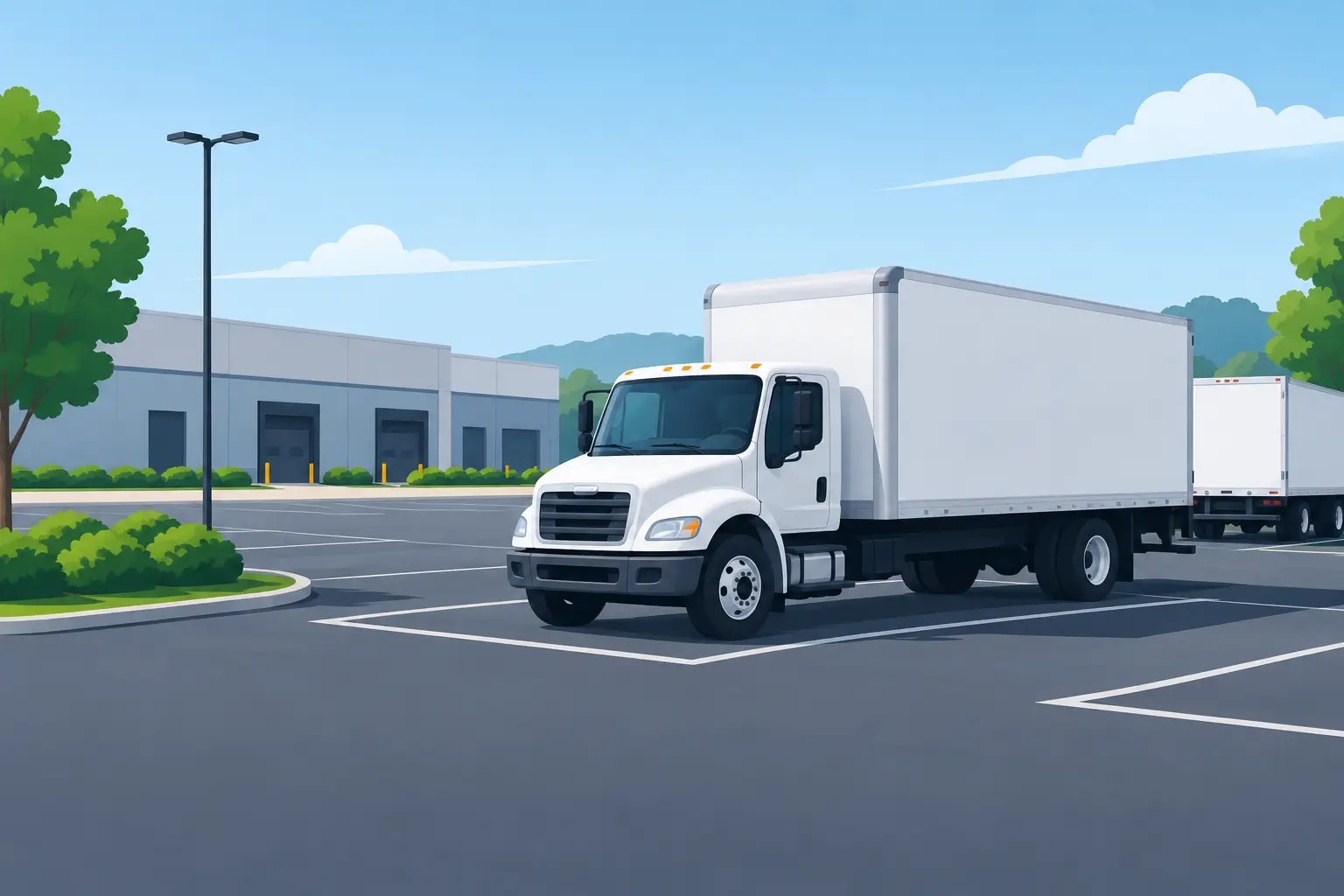
A box truck may be smaller than a tractor-trailer, but it still needs more than an open patch of pavement. The best box truck parking gives a driver a predictable way in, enough room to position the vehicle, clear rules for the stay, and a dependable way out when the next delivery starts. For property owners, that difference matters. A site that works operationally can become useful recurring capacity. A site that only looks large on a map can create avoidable conflict.
Box truck parking serves a wide mix of users: local delivery operators, moving companies, contractors, retail replenishment fleets, service businesses, and owner-operators running regional routes. Their vehicles may be 16, 20, 26, or more feet long, with different wheelbases, liftgates, roof heights, and parking schedules. Good parking is not just about fitting a vehicle inside a property line. It is about matching the site to the vehicle, the route, and the operating boundaries.
What Makes the Best Box Truck Parking
The right location starts with practical access. A driver needs to approach the entrance without tight turns, low clearance hazards, residential restrictions, or a route that forces backing into traffic. A wide gate is helpful, but entrance geometry matters just as much. A box truck with a long wheelbase can struggle at a narrow driveway even when the parking area itself is spacious.
Once inside, the driver needs a usable path to the assigned space. That means accounting for turning movement, parked vehicles, loading areas, islands, fences, dumpsters, and other fixed obstacles. A property can have enough total acreage and still have very little usable truck capacity. The question is not, “How many vehicles fit if everything is packed in?” The better question is, “How many vehicles can enter, park, and exit safely during normal operations?”
Surface condition is another deciding factor. Paved lots are often the easiest fit, particularly for recurring overnight or multi-day parking. Compacted gravel or stabilized ground may also work when it remains firm in wet weather and can handle repeated vehicle weight without deep ruts. Soft ground, uneven grades, standing water, and poorly maintained surfaces create problems for drivers and owners alike.
A good site also has visible boundaries. Drivers should know where to park, which areas are off limits, whether idling is permitted, what hours apply, and how access is handled. Clear instructions reduce the chance that a delivery vehicle blocks a tenant, uses an active loading zone, or parks where a property owner needs daily access.
Parking Needs Change by Box Truck Use
There is no single box truck profile. A 16-foot vehicle used by a local contractor may need a straightforward overnight spot near a service territory. A 26-foot moving truck may need more turning room and space to open a rear ramp. A fleet with several branded delivery vehicles may prioritize recurring capacity, consistent access hours, and parking close to its first or last stop of the day.
That is why parking searches should begin with operating details, not just a city name. Drivers and dispatchers benefit from defining the vehicle length, height, number of vehicles, arrival time, departure window, length of stay, and any access needs before selecting a site. These details help avoid a common failure: booking a space that is technically available but operationally wrong.
For property owners, the same information makes site decisions easier. A site may be a strong fit for smaller box trucks but not for 26-foot trucks, or suitable for daytime staging but not overnight parking. Those are not weaknesses. They are useful boundaries. Capacity works better when it is offered honestly and matched to the vehicles the property can handle.
Access Is Worth More Than a Convenient Address
A well-located lot is valuable, but a convenient address cannot make up for bad truck access. Box truck drivers often operate on tight schedules, especially in dense metro areas where delivery windows, customer appointments, and traffic conditions shape the day. They need a parking location that supports the route rather than adding a difficult detour at the beginning or end of each shift.
Route approach should be checked from the driver's perspective. Look at the roads immediately surrounding the property, the direction of travel into the entrance, nearby rail crossings, bridge clearances, and turns at major intersections. A location near a highway may still be impractical if the final mile requires navigating narrow industrial streets or restricted local roads.
In urban and suburban markets, entry and exit timing can matter as much as distance. A gate that is available only during regular business hours may not work for a delivery fleet leaving before dawn. A property with controlled access can still be a good parking option, but the procedures need to match the operator's schedule. Gate codes, assigned contacts, and advance instructions should be confirmed before the first stay, not figured out after a driver arrives.
Security Should Fit the Operation
Not every box truck parking site needs the same security setup. A driver making a single overnight stop may simply need a defined, well-lit place that is separated from public street parking. A fleet leaving equipment or inventory in vehicles may need stronger controls, such as fencing, gated entry, cameras, or a managed yard environment.
The key is to describe conditions accurately. Promising more than a site provides creates the wrong expectations. Property owners should state whether the lot is fenced, how entry is controlled, whether lighting covers the parking area, and whether there are active businesses or personnel on site. Drivers and fleet managers can then decide whether those conditions fit the equipment and cargo involved.
Security also includes operational order. Clearly marked parking areas, designated traffic paths, and restrictions around loading docks or tenant spaces help protect the property. A quiet, organized site is generally easier to manage than one where every vehicle is left to choose its own position.
The Owner's View: Put Excess Capacity to Work
For an industrial property, warehouse yard, contractor facility, or business with unused paved ground, box truck parking can be a practical incremental revenue opportunity. It usually requires less space and less specialized maneuvering room than full tractor-trailer parking, although every site still needs review. A property owner does not need to turn the entire facility into a public parking lot to make a few usable spaces available.
The best starting point is a realistic assessment of capacity. Consider the road approach, gate width, internal turns, surface condition, drainage, lighting, existing tenant traffic, and areas that must remain off limits. Photos and a marked site map can answer many of these questions quickly. One map, six useful photos, and a clear explanation of the operating boundaries are more valuable than a vague claim that trucks can park there.
Owners should also protect their current business. If a yard already serves tenants, customers, vendors, or direct parking clients, new parking activity has to work around those relationships. A nonexclusive channel can be useful because it adds demand without requiring the owner to abandon existing sales or third-party listings. Benchmark Truck Parking works from that premise: evaluate the site, confirm the terms, and add capacity only where the operational fit is clear.
Price the Space Around Reality
Parking rates depend on more than local demand. A secure, well-lit, paved site with easy truck access and flexible hours can justify a different rate than an open lot with limited access. Recurring monthly users may value consistency and reserve capacity well in advance. Daily users may need flexibility, especially when their routes change.
The right rate also reflects the burden on the property. If a space creates extra gate management, requires a defined travel lane, or limits how owners use part of the yard, that should be reflected in the terms. If the space sits unused and can be accessed without disrupting regular operations, the arrangement may be simpler. There is no universal rate because the value comes from local demand and usable conditions, not from square footage alone.
Confirm Before You Commit
The most reliable parking arrangements are specific. Drivers should receive the exact location, arrival procedure, designated parking area, pricing, and access instructions before payment and arrival. Fleets should confirm how many vehicles can be accommodated, whether spaces are assigned, and what happens if schedules change. Property owners should know who is coming, what vehicle they are bringing, and which part of the property they may use.
That level of confirmation may feel more deliberate than an open-ended listing, but it prevents avoidable surprises. It protects the driver's time, the fleet's schedule, and the owner's property.
Good box truck parking is not defined by the largest lot or the lowest nightly price. It is defined by a workable match between vehicle, access, surface, schedule, and boundaries. When those details are clear before the first truck arrives, unused ground can become dependable capacity instead of another operational problem.
More articles · Truck parking locations · List your property