Commercial Vehicle Parking That Fits Your Site
October 16, 2026
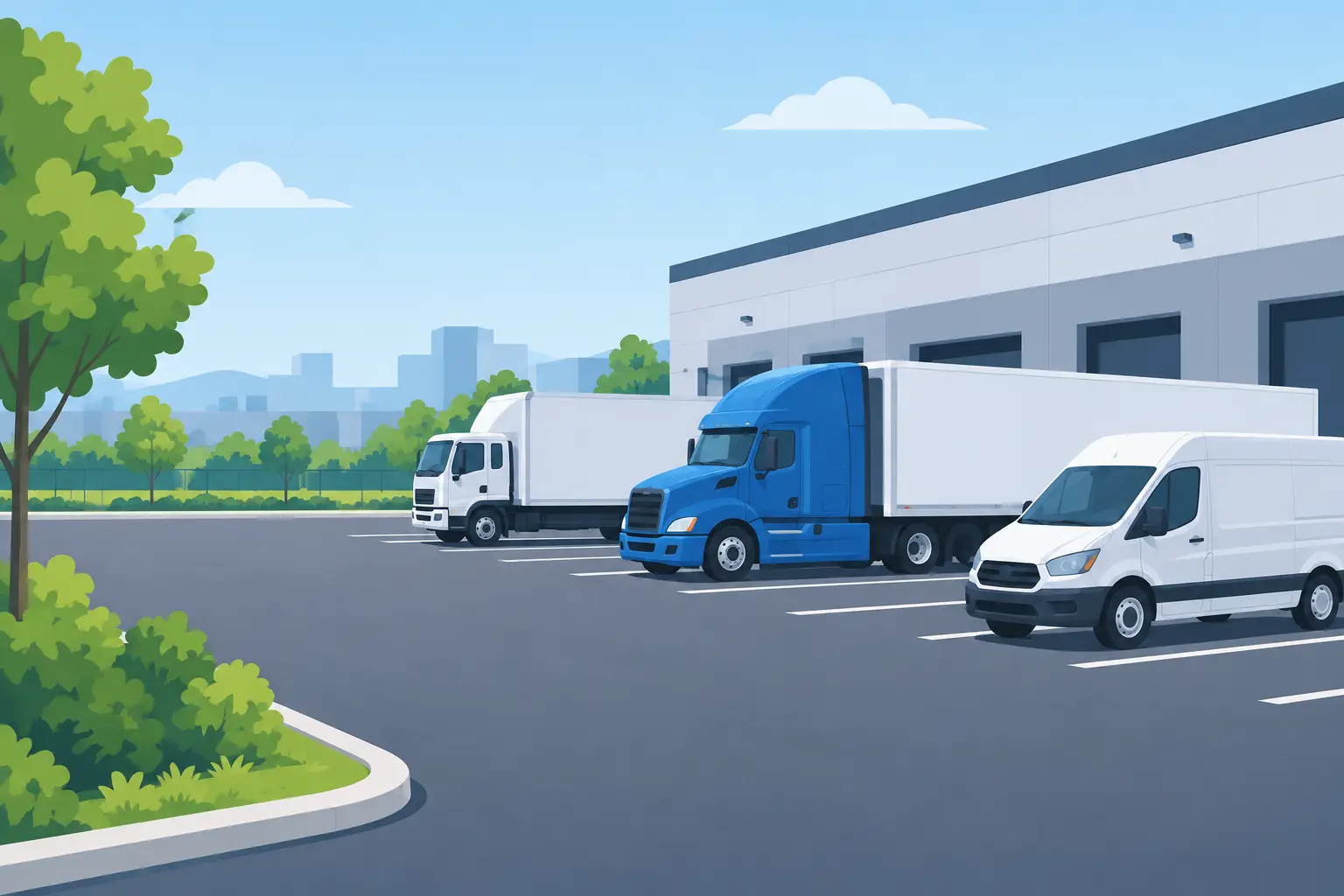
A vacant paved section behind a warehouse may look like easy revenue. But commercial vehicle parking only works when a truck can approach, enter, turn, park, and leave without disrupting the property’s primary operation. The difference between usable capacity and a costly headache is usually found in the details: entrance geometry, surface condition, truck route, site boundaries, and the type of vehicle the space is meant to serve.
For property owners, the opportunity is straightforward. Demand for truck and commercial vehicle parking exists near freight corridors, industrial areas, warehouses, ports, distribution centers, and places where legal overnight capacity is limited. Yet not every open lot should become parking. A practical site review protects the owner, gives drivers clear expectations, and helps fleets rely on capacity that matches their equipment and schedules.
What Commercial Vehicle Parking Actually Requires
Commercial vehicle parking is broader than a row of tractor-trailers. Depending on the site, it may include tractors, trailers, tractor-trailer combinations, box trucks, work vehicles, or fleet equipment parked for a night, a week, or on a recurring monthly arrangement.
That range matters because vehicle size changes the operating requirements. A box truck may fit through an entrance that is too tight for a sleeper cab and 53-foot trailer. A tractor-only space can use less depth than a combined unit. A site with compacted gravel may be suitable for some equipment, while a heavily traveled tractor-trailer area may need a more durable surface and clear drainage.
The right question is not, “How many vehicles fit on this property?” It is, “What equipment can use this property safely, repeatedly, and without interfering with the business already here?” That answer determines usable capacity, pricing, site rules, and whether daily, monthly, or recurring parking makes sense.
Start With Access, Not Acreage
Land size is only part of the equation. A sizable yard with a difficult approach can be less valuable than a smaller site with a wide entrance, straightforward turns, and direct access from truck-appropriate roads.
Review the full vehicle path before counting spaces. Consider the road a driver uses to reach the property, the driveway width, gate placement, overhead clearance, turning radius, and the route from the entrance to each parking area. A driver who must back into active customer traffic, cross a loading area, or make a blind turn around a building is being asked to take on unnecessary risk.
Access also needs to work at the times parking customers will arrive. A site may be easy to enter at noon but difficult after dark, during employee shift changes, or when nearby loading docks are active. If the property has a gate, confirm who controls it, how drivers receive access instructions, and whether arrivals can be accommodated outside normal office hours.
Surface, drainage, and seasonal conditions
Parking surface affects more than appearance. Soft ground, broken pavement, standing water, steep grades, and unmarked obstructions can create damage claims, recoveries, or unsafe conditions. A surface does not have to be perfect to be useful, but its condition should match the equipment and traffic level expected.
Property owners should be clear about seasonal limitations. In northern markets, snow storage and plowing routes can reduce winter capacity. In areas with frequent heavy rain, drainage can determine whether a gravel section remains functional. If a portion of the yard should be closed in certain conditions, that boundary should be established before it is offered for parking.
Lighting is another practical consideration. It supports nighttime arrival, helps drivers identify assigned areas, and makes property rules easier to follow. It is not a substitute for controlled access or active security, so it should never be described as more than it is.
Define Boundaries Before You Add Capacity
The strongest parking arrangements make off-limits areas obvious. A driver should know where to enter, where to park, which lanes must remain open, where not to turn around, and whether on-site amenities are available. Ambiguity creates friction for everyone.
This is especially important for operating businesses. An owner may have extra ground near the perimeter but need loading doors, employee parking, customer access, maintenance areas, storage lanes, or fire routes kept clear at all times. Commercial vehicle parking should use the excess capacity, not consume the space that keeps the main operation moving.
A basic operating plan can be simple, but it should answer four distinct questions:
- Which entrance and route should commercial vehicles use?
- What vehicle types and lengths are permitted?
- Which spaces, lanes, gates, and buildings are off-limits?
- Who should a driver contact if access instructions do not work?
Photos and a marked site map reduce avoidable confusion. One map showing the entrance, parking area, travel path, and restricted zones can prevent the kind of wrong turn that becomes a property-management problem. Current photos should show the real approach and parking surface, not just the best-looking angle of the yard.
Choose a Parking Model That Matches the Property
Daily parking can work well when a site has variable open capacity and local demand for short stays. Monthly parking is often a better fit when an owner wants more predictable occupancy and fewer arrivals. Recurring fleet arrangements may make sense when a carrier needs route-aligned capacity for specific equipment on defined days or shifts.
There is no universal best model. A property beside a busy freight route may benefit from short-term demand, while a yard near a fleet terminal may be more valuable as recurring trailer or tractor capacity. Some owners can support both, as long as the inventory is controlled and the primary business retains priority.
The trade-off is operational involvement. More turnover can create more revenue opportunities, but it also means more access coordination. Longer-term capacity can be easier to manage, though it reduces flexibility if the owner suddenly needs the ground for a contract, expansion, or seasonal inventory. Good parking terms leave room for that reality.
Benchmark Truck Parking approaches this by reviewing the site first, confirming the operating fit, and treating parking as an additional revenue channel rather than an all-or-nothing platform change. Property owners can preserve existing direct customers and third-party listings while evaluating whether additional demand fits their available capacity.
Price the Usable Space, Not the Idealized Space
Parking rates should reflect actual site conditions and local demand, not just a theoretical space count. A secure, easy-to-access paved site near major truck activity has different value than a remote overflow lot with limited arrival hours. Equipment type also matters. A tractor-only space, trailer storage space, and tractor-trailer space should not be treated as identical inventory.
Before setting a rate, account for the owner’s operating boundaries. If parking is restricted to certain hours, requires a gate process, or excludes particular vehicle types, those terms should be clear before a driver arrives. Pricing cannot fix a site that is hard to use, but clear pricing and accurate expectations can attract the right users.
For owners who do not want to build a booking operation, a revenue-share model can reduce setup burden. The important details are still practical: who evaluates the property, how availability is confirmed, when payouts occur, what revenue is included, and how existing relationships are protected. A simple arrangement is only useful if the rules are easy to verify.
Confirm the Details Before Payment or Arrival
For drivers and fleets, broad availability claims are not enough. They need a confirmed location, compatible space, dates, price, and access instructions. A fleet manager may also need assurance that recurring units can be accommodated without being displaced by short-term demand.
Request-based booking helps control this process. Instead of assuming every listed space fits every vehicle, the parking operator can confirm the exact equipment, length, stay, and arrival needs before finalizing the arrangement. That approach takes a little more coordination upfront, but it avoids sending a driver to a site that cannot handle the vehicle.
Property owners benefit from the same discipline. They retain the ability to assess whether a request fits the yard, whether the requested dates conflict with business activity, and whether the equipment belongs in the designated area. Clear confirmation protects capacity and prevents a parking arrangement from becoming an unmanaged open gate.
Put Idle Ground to Work Without Giving Up Control
Suitable commercial vehicle parking can produce incremental income from ground that is already present, but it should remain subordinate to the property’s real operating needs. The best sites are not necessarily the largest. They are the sites with workable truck access, honest capacity, defined boundaries, and terms that match the owner’s willingness to manage arrivals.
If a section of your property can safely handle commercial vehicles, begin with the physical facts: mark the route, identify usable parking, photograph the conditions, and state the restrictions plainly. That gives drivers and fleets something they can rely on, while keeping control of the ground where it belongs.
More articles · Truck parking locations · List your property