Exclusive vs Non-Exclusive Truck Parking Agreements
November 4, 2026
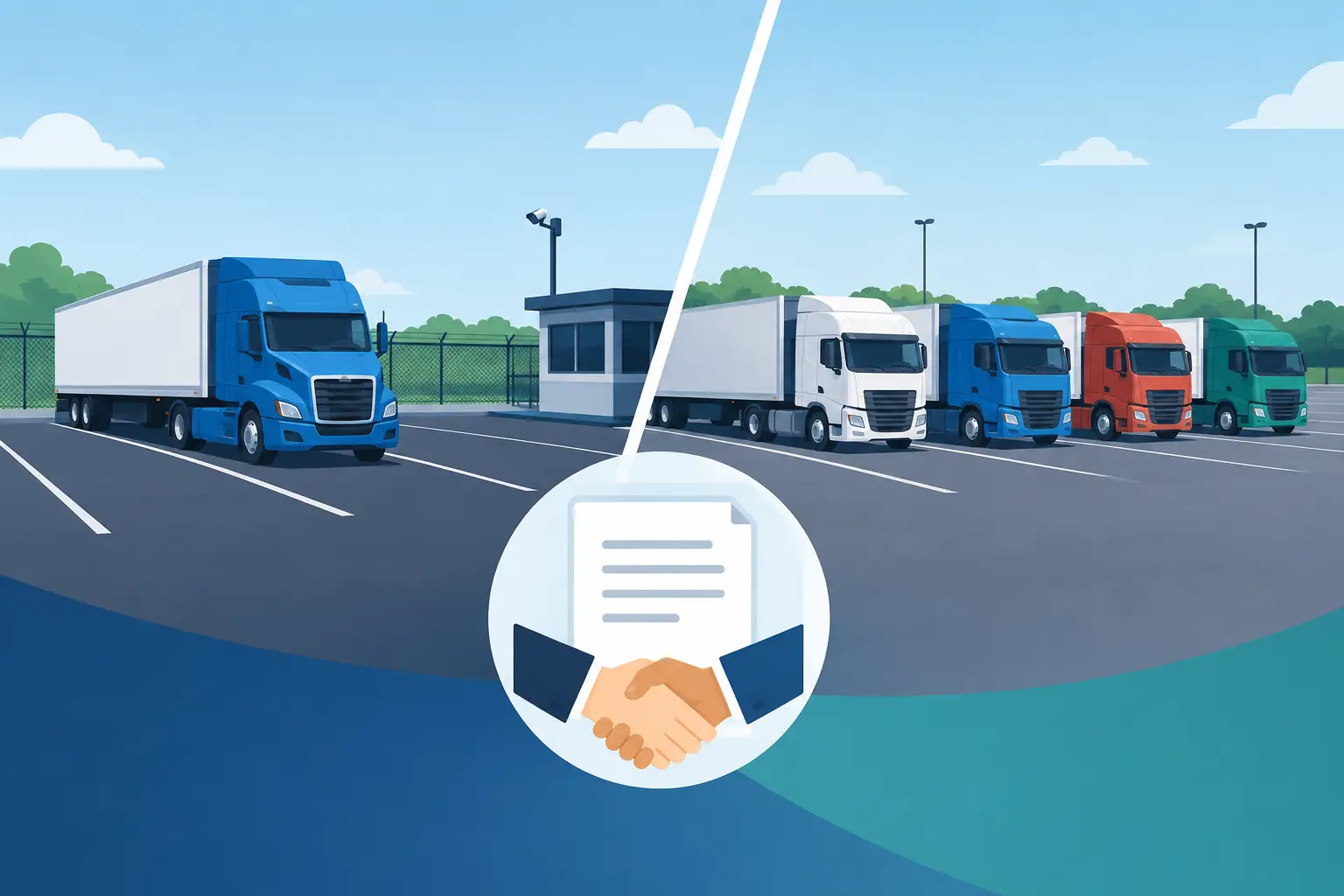
If you own an industrial property, commercial yard, or parking facility with unused space, partnering with a truck parking company offers an opportunity to generate additional revenue.
But before signing an agreement, there's an important question to answer.
Should you give one parking company exclusive control of your available spaces, or maintain the flexibility to work with multiple providers?
The difference affects your revenue opportunities, existing customer relationships, and control over your property.
Understanding exclusive vs. non-exclusive truck parking agreements helps you choose an arrangement that supports your business rather than limits it.
What Is an Exclusive Truck Parking Agreement?
An exclusive truck parking agreement gives one company the sole right to market, manage, or operate designated parking capacity.
Depending on the contract, exclusivity might apply to a specific parking area, certain vehicle types, or the entire property.
For example, an industrial property owner might agree to let one truck parking operator manage 50 designated spaces.
Under an exclusive arrangement, the owner may be restricted from accepting direct parking customers or working with competing parking marketplaces for those spaces.
The exact restrictions depend on the agreement.
Advantages of Exclusive Agreements
Exclusivity sometimes makes sense when an operator assumes responsibility for an entire parking operation.
Potential benefits include:
- One company managing reservations and customers
- A single operating process
- Centralized pricing and inventory management
- Potential financial commitments from the operator
- Reduced coordination between multiple parking channels
However, these advantages need to justify the restrictions placed on the property owner.
Disadvantages of Exclusive Agreements
The biggest concern is lost flexibility.
An exclusive agreement might prevent an owner from accepting a direct monthly parking customer, working with another marketplace, or using committed spaces for another business opportunity.
Consider a property owner who has 20 available truck parking spaces.
If an exclusive operator controls all 20 spaces but consistently rents only five, the remaining 15 might sit empty even when other customers are interested.
Whether the owner can pursue those opportunities depends on the contract.
Exclusivity does not guarantee occupancy or revenue.
Before signing, owners should understand what the operator is committing to deliver in exchange for exclusive rights.
What Is a Non-Exclusive Truck Parking Agreement?
A non-exclusive truck parking agreement allows property owners to generate revenue through a parking partner while maintaining the ability to serve existing customers and work with other providers.
Instead of giving one company sole control of the available capacity, the owner retains flexibility.
For example, an industrial yard might have 30 usable truck parking spaces.
The owner already rents 10 spaces directly to local businesses and markets another five through an existing platform.
Under a properly structured non-exclusive agreement, the owner can continue those relationships while making additional capacity available through Benchmark Truck Parking.
The arrangement creates another source of potential parking revenue without requiring the owner to replace existing business.
This is the foundation of Benchmark Truck Parking's standard marketplace model.
We work with property owners to market suitable available capacity while protecting their existing direct customer and third-party platform relationships.
Exclusive vs. Non-Exclusive Truck Parking: Key Differences
| Feature | Exclusive | Non-Exclusive | |---|---|---| | Work with multiple marketplaces | Often restricted | Permitted | | Keep existing direct customers | Depends on contract | Preserved under Benchmark's model | | Accept new direct customers | May be restricted | Permitted | | Property control | Subject to exclusive rights | Owner retains flexibility | | Multiple revenue channels | Potentially limited | Supported | | Inventory coordination | Usually centralized | Requires coordination | | Long-term flexibility | Depends on contract | Generally greater |
Neither arrangement is automatically right for every property.
The important question is whether the agreement creates enough value to justify the control or flexibility the owner gives up.
Why Non-Exclusive Truck Parking Agreements Benefit Property Owners
1. Keep Your Existing Parking Revenue
Property owners should not have to sacrifice established customers to pursue new ones.
If you already rent spaces directly to trucking companies, contractors, or commercial fleets, those relationships have value.
Benchmark's non-exclusive model allows owners to maintain existing direct parking business.
Our standard revenue share applies to eligible parking revenue collected through Benchmark, not the owner's independent direct sales.
2. Add Another Revenue Channel
A property does not need to rely on one company to generate all its parking customers.
Multiple channels can expose available capacity to different types of demand.
One marketplace might attract overnight drivers. Another might generate monthly parking inquiries. Direct relationships might bring in local fleet operators.
Adding Benchmark provides another opportunity to reach customers without replacing the channels already working.
3. Maintain Control Over Your Property
Parking should work around the property's existing operations.
An industrial yard may need room for deliveries, equipment staging, or tenant activity.
A warehouse might have available capacity overnight but require the same area during business hours.
A non-exclusive arrangement allows owners to define which areas are available and establish operating requirements.
The agreement should clearly identify how capacity changes are communicated and how existing reservations are protected.
4. Reduce Dependence on One Provider
No parking marketplace can guarantee consistent demand at every location.
Local competition, pricing, freight activity, and customer requirements all influence bookings.
Depending entirely on one operator creates additional business risk if that operator fails to produce sufficient revenue.
A non-exclusive model gives owners the flexibility to pursue other opportunities while evaluating the results from each channel.
How Much Can Property Owners Earn?
The revenue opportunity depends on usable capacity, pricing, occupancy, and local demand.
Consider an industrial property with 10 truck parking spaces available at $225 per month.
At full monthly occupancy, those spaces would generate $2,250 in gross parking revenue.
Under Benchmark Truck Parking's standard marketplace arrangement:
| Revenue breakdown | Monthly amount | |---|---:| | 10 spaces at $225 | $2,250.00 | | Property owner share (75%) | $1,687.50 | | Benchmark share (25%) | $562.50 |
This example assumes all 10 spaces are rented through Benchmark for the full month. It illustrates the revenue split, not a forecast or guaranteed result. Applicable payment processing fees and other agreed costs can affect the owner's final payout.
The advantage of non-exclusivity is that owners retain the ability to generate additional parking revenue through their own direct customers and other permitted channels.
Benchmark's revenue share does not apply to independent direct parking sales under its standard marketplace model.
How Benchmark Truck Parking's Non-Exclusive Model Works
Benchmark Truck Parking partners with owners of industrial properties, commercial yards, existing parking facilities, and other locations suitable for commercial vehicle parking.
Our goal is straightforward: generate additional parking business from available capacity without requiring owners to surrender their existing relationships.
Property Evaluation
We review available parking areas, vehicle access, turning requirements, surface conditions, and operating restrictions.
Not every property is suitable for every type of commercial vehicle.
A location might accommodate tractor-trailers, bobtails, box trucks, dropped trailers, commercial fleets, or other approved vehicles.
The usable capacity determines what can be offered.
Parking Rates and Availability
We work with owners to establish appropriate rates and parking options.
Depending on the location, these may include daily, weekly, and monthly reservations.
Owners identify available areas and operating boundaries so parking activity does not interfere with existing operations.
Marketing and Customer Acquisition
Benchmark markets participating locations to drivers, commercial fleets, contractors, and businesses seeking parking.
Marketing efforts may include online advertising, parking listings, and direct outreach to potential customers.
Reservations and Payments
Benchmark coordinates reservations, collects payments through its platform, and provides customer support for Benchmark bookings.
The owner maintains control of the property and continues managing independent customer relationships.
Revenue Sharing
Under the standard marketplace model, property owners receive 75% of Benchmark-collected parking revenue, subject to applicable processing fees and agreed terms.
Benchmark retains 25%.
The arrangement is non-exclusive, allowing owners to maintain other parking relationships.
What Should Property Owners Look for in a Truck Parking Agreement?
Before signing with any parking provider, review the agreement carefully.
Exclusivity: Does the contract prevent you from working with another marketplace or accepting direct customers?
Revenue sharing: What percentage of collected parking revenue do you receive, and which transactions are subject to the agreement?
Payment terms: How frequently are payments made, and what fees or adjustments apply?
Parking capacity: Which spaces are committed, and how are changes to availability handled?
Property access: Who establishes entrance instructions, permitted vehicle types, access hours, and restricted areas?
Existing customers: Are current direct parking relationships protected?
Termination: How does either party end the agreement, and what happens to active reservations?
Liability and insurance: What responsibilities does each party assume?
Owners should also confirm that the proposed parking use complies with applicable zoning, lease requirements, insurance conditions, and local regulations.
A well-written agreement should establish clear expectations before the first reservation.
Is a Non-Exclusive Truck Parking Agreement Right for Your Property?
For owners who want additional parking revenue without giving up existing business, a non-exclusive agreement offers meaningful flexibility.
It is especially relevant for:
- Industrial property owners with unused yard space
- Warehouses with available commercial vehicle parking
- Existing parking operators looking for another demand channel
- Trucking companies with excess parking capacity
- Commercial landlords with underused paved or gravel areas
- Contractors and fleet operators with available vehicle storage space
The arrangement works best when capacity is clearly defined and participating parties coordinate availability.
Non-exclusive does not mean unlimited inventory or unrestricted access.
It means owners have more freedom to decide how their property participates in the parking market.
Partner With Benchmark Truck Parking
You shouldn't have to choose between keeping your existing parking customers and attracting new ones.
Benchmark Truck Parking offers property owners a non-exclusive way to market available commercial vehicle parking.
We help evaluate your property, establish parking options, market available spaces, coordinate reservations, and collect payments.
You keep 75% of Benchmark-collected parking revenue under our standard marketplace model. Your existing direct customers and other parking relationships remain yours.
Whether you have five available truck spaces or a large industrial yard, we can evaluate the opportunity.
Visit BenchmarkTruckParking.com to learn more about partnering with Benchmark Truck Parking and turning unused parking capacity into additional revenue.
More articles · Truck parking locations · List your property