How to Price Overflow Space for Truck Parking
October 25, 2026
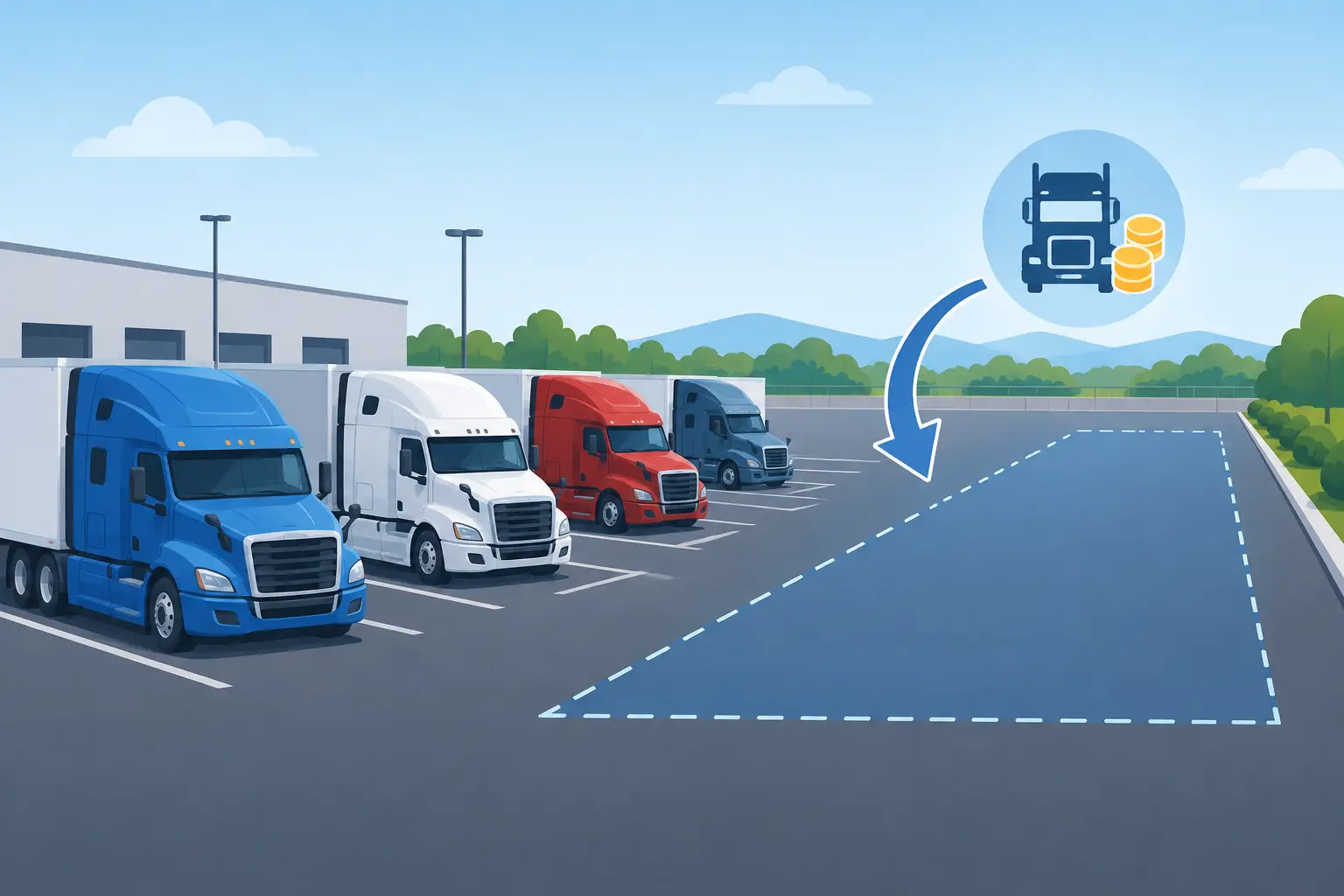
A vacant section of yard can look like easy income until the first truck cannot make the turn, blocks an active gate, or stays three days longer than expected. Knowing how to price overflow space starts with a more practical question: what capacity can you offer consistently without interfering with your own operation?
The right rate is not simply a local average multiplied by the number of spaces. Truck parking is a physical operating service. Access, maneuvering room, surface condition, vehicle type, stay length, and the boundaries you set all affect what the space is worth and whether the revenue is worth accepting.
Start with usable capacity, not acreage
A five-acre property does not automatically have room for 50 trucks. The number that matters is the number of commercial vehicles that can enter, park, and leave safely while your own customers, staff, deliveries, and equipment continue moving.
Begin with the actual parking area. Exclude building setbacks, drainage areas, fire lanes, loading zones, turning paths, employee parking, storage, and any ground that becomes unreliable in wet weather. Then consider the truck types you can accept. A paved area that works well for box trucks may not have the entrance width or turning radius for a tractor-trailer combination.
This is where owners often overprice capacity without meaning to. If your yard can physically hold 20 trailers but only 12 can be parked without blocking an exit or creating difficult backing moves, price 12 dependable spaces. A smaller, workable inventory is more valuable than a larger number that creates daily exceptions.
For overflow space, it can also make sense to set aside capacity only during certain hours, days, or seasons. That restriction should be reflected in the rate and stated clearly before a booking is confirmed.
Price the operating fit before the market rate
Local demand sets the range, but operating fit determines where your site belongs within that range. A truck parking location generally commands more when it has a straightforward road approach, a clear entrance, adequate turning room, a firm parking surface, and predictable access instructions.
A site with a tight entrance, limited lighting, gravel that softens after rain, or restricted hours can still have value. It just should not be priced as if it offers the same experience as a fully improved commercial yard. The goal is not to apologize for a site's limits. It is to put a fair price on the capacity it can reliably provide.
Consider the factors that drivers and fleets actually plan around:
- Distance from freight corridors, warehouses, ports, intermodal facilities, or regular delivery routes
- Whether a tractor, trailer, or combined unit can enter and exit without difficult maneuvers
- Surface quality, drainage, lighting, fencing, and the general security of the parking area
- Hours of access, gate procedures, check-in requirements, and whether space is available on short notice
- Rules on idling, maintenance, trailer storage, hazardous materials, overnight occupancy, and off-limits areas
Not every property needs every feature. A basic trailer-storage yard may be well suited to monthly parking, while a location near a busy route with dependable 24-hour access may support higher daily rates. Price the actual use case rather than chasing a generic “premium” label.
Use daily, monthly, and recurring rates differently
A daily rate pays for flexibility. It fits drivers or dispatchers who need a defined place for one night, a few days, or an uncertain-length layover. Because short stays create more movement, more communication, and more turnover, the daily rate should normally be the highest rate on a per-day basis.
Monthly parking trades some of that flexibility for dependable occupancy. A monthly customer is often easier to plan around, particularly for trailers or assigned fleet equipment. The monthly discount should be meaningful enough to encourage commitment, but not so steep that it undercuts the value of your limited capacity during high-demand periods.
Recurring fleet capacity is its own category. If a fleet needs a set number of spaces every week or every month, the rate should account for the fact that those spaces cannot be sold elsewhere. In return, predictable volume and a clear operating schedule can reduce vacancy and simplify management.
A practical structure may include a daily rate, a monthly rate, and a separately quoted recurring fleet rate. Avoid publishing a rate that applies to every vehicle, every duration, and every access condition. A 53-foot trailer stored for a month is not the same operating use as a tractor arriving late at night and departing before dawn.
Build your floor rate from real costs and constraints
Before deciding what the market will bear, establish the minimum return that makes the arrangement worthwhile. This is not just a property-tax exercise. Include the costs and risks created by commercial vehicle activity.
Your floor rate should account for surface wear, drainage maintenance, lighting and utility costs, gate or access administration, insurance considerations, security measures, snow removal where applicable, and the value of the area if you need it back for your own operation. If additional truck movement creates a problem for neighbors, employees, or adjacent tenants, that is an operational cost too, even if it does not appear as a line item on an invoice.
Then consider occupancy. A lower rate with dependable monthly utilization may produce more useful income than a high advertised rate that leaves the yard empty. On the other hand, a constrained site near an active freight market may be better served by preserving availability for higher-value short stays.
The right answer depends on whether your priority is predictable supplemental revenue, maximum yield during peak demand, or a balance of the two.
Set boundaries that protect the price
Pricing only works when the offered space is clearly defined. If drivers arrive expecting open access, unrestricted parking, or services you did not intend to provide, the rate will not cover the friction that follows.
Document the parking area on a simple map. Identify the entrance, travel path, parking rows, gate instructions, speed expectations, and areas that are not available. Photos are useful because they show the approach, surface, striping, obstacles, and turning conditions better than a short description can.
Be direct about vehicle compatibility. State whether you accept tractors, trailers, tractor-trailer combinations, box trucks, or only certain lengths. Define access hours, whether reservations are required, and what happens if a vehicle remains past its approved stay. If you do not allow maintenance, dumping, idling, or overnight driver occupancy, say so before the booking.
Clear boundaries are not just a risk-control measure. They support stronger pricing because customers know what they are buying. A fleet manager can justify a recurring rate when the access plan is consistent. A driver is more likely to book when the entry process and parking location are specific.
Test the rate with controlled availability
There is no need to make a permanent pricing decision before you have operating data. Start with a limited number of spaces, defined vehicle types, and a rate that reflects the site as it exists today. Review demand, booking lead time, stay duration, and the number of requests you decline because the fit is wrong.
If the space books quickly and reliably, raise the rate gradually or reserve some capacity for longer-term customers. If demand is weak, do not assume the answer is immediately a lower price. Check whether drivers can find the entrance, whether access instructions are clear, whether the site is compatible with the equipment being requested, and whether your availability matches actual freight activity nearby.
Benchmark Truck Parking approaches this as a site and capacity decision first. Owners retain their direct customers and other listing relationships while adding a nonexclusive revenue channel. The review should focus on usable space, access, restrictions, and local demand before any exact rate is confirmed.
When a lower rate is the better business decision
A lower rate can be sensible when it buys predictability, reduces vacancy, or fills capacity that would otherwise sit unused. It can also make sense for a fleet that follows your rules, uses a defined area, and creates less administrative work than a series of short-term arrivals.
But discounting should have a reason. Do not lower the price simply because a prospect asks. Tie any reduced rate to a longer commitment, guaranteed volume, restricted access window, trailer-only use, or another condition that gives your property something in return.
The best truck parking price is one that pays fairly for the space you can truly spare, while leaving your primary business in control. Start with a clear map, a realistic space count, and boundaries you can enforce. The rate becomes much easier to set once the operating fit is clear.
More articles · Truck parking locations · List your property