Industrial Land Lease for Commercial Truck Parking
October 17, 2026
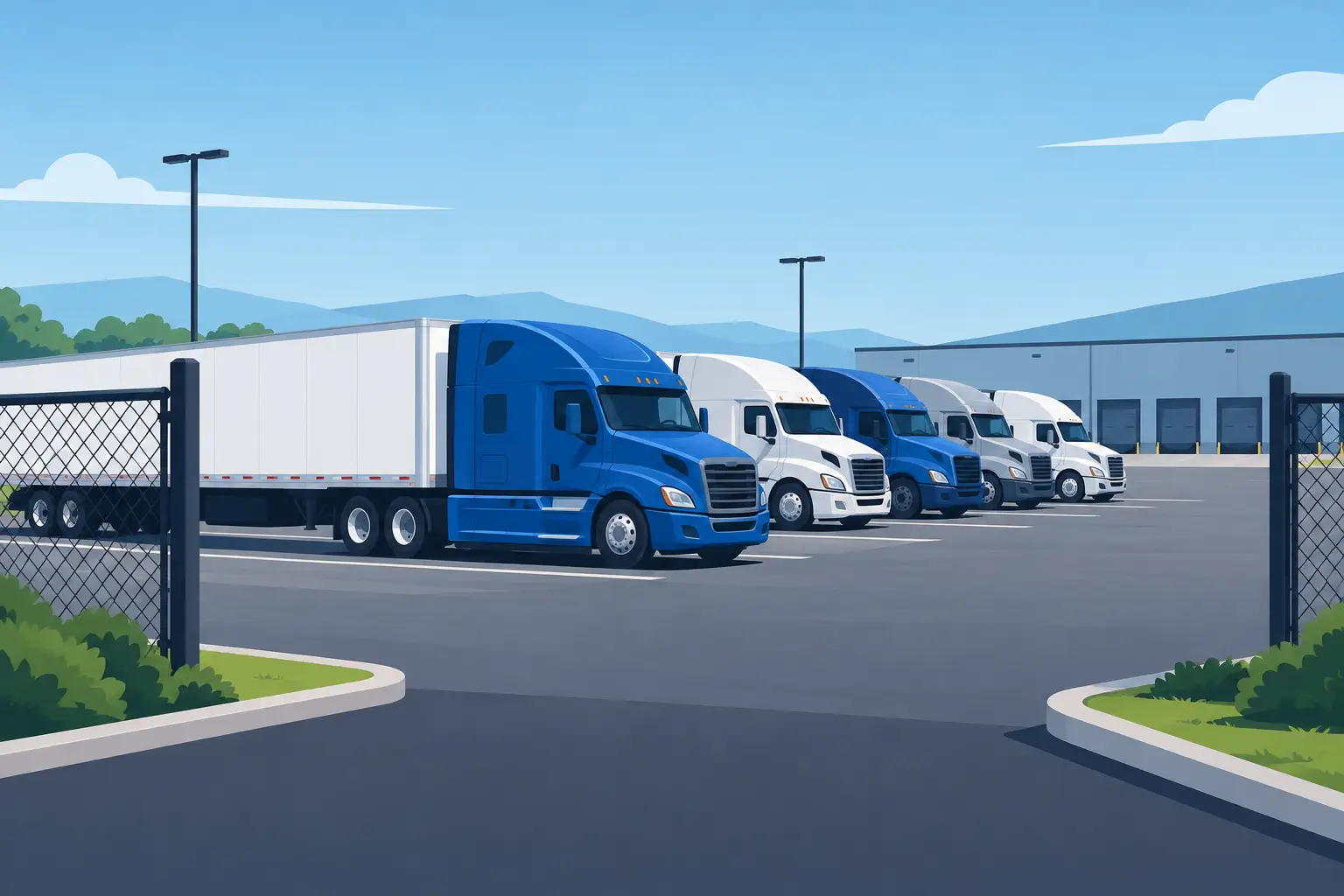
A workable industrial land lease is not defined by acreage alone. A five-acre parcel with a narrow entrance, weak pavement, and no practical turn path may be a poor fit for trucks. A smaller yard with a wide driveway, durable surface, defined boundaries, and a route that keeps trucks off neighborhood streets can be far more valuable.
For property owners, truck parking can turn underused ground into recurring income without changing the primary purpose of the property. But it only works when the operating plan matches the site. The question is not simply, “Can a truck fit?” It is whether commercial vehicles can enter, park, exit, and return without creating conflicts with tenants, customers, employees, neighbors, or existing operations.
When an Industrial Land Lease Fits Truck Parking
An industrial land lease for truck parking is often a practical option when a property has excess paved yard, stabilized ground, unused trailer storage space, or a portion of a larger site that does not serve daily business activity. It can also fit owners who have demand nearby but do not want to build a full parking operation, hire on-site staff, or give up their current customers.
Location matters, but road approach matters just as much. A site near an interstate, warehouse district, port route, manufacturing corridor, or major freight market may have strong demand. Yet drivers and fleet managers still need to know whether they can safely reach the gate, make the turns, and leave on schedule. A property that looks convenient on a map can fail in practice if the last mile includes low clearances, weight restrictions, tight residential corners, or a difficult left turn across traffic.
The best sites usually have a clear operating edge. That might be a fenced rear yard, a separate gravel lot, a former equipment-storage area, or marked spaces along an underused perimeter. Separating truck activity from the owner’s core operation reduces confusion and makes access instructions easier to enforce.
A lease may be the right structure when one fleet needs dedicated capacity for a set term. A monthly arrangement can work for an owner-operator or a small group of drivers with predictable schedules. In other cases, a revenue-share channel makes more sense because demand changes by day, season, route, and local freight activity. The right model depends on how much capacity is available, how consistent demand is, and how much control the owner wants over use of the space.
Evaluate the Site Before Setting Lease Terms
Before discussing price, review the physical conditions that decide whether truck parking is truly operational. This step protects the property owner as much as the driver or fleet. A reasonable rate cannot fix an entrance that causes trailers to track across landscaping, a surface that breaks down in wet weather, or a circulation pattern that blocks loading docks.
Start with the approach and entrance. Consider the truck routes that lead to the property, the width of the driveway, gate placement, overhead clearance, sightlines, and room to swing a tractor-trailer into the site. A tractor alone, a box truck, an empty 53-foot trailer, and a full tractor-trailer combination do not use space the same way. The intended vehicle types should be stated early rather than assumed.
Then assess maneuverability inside the property. Drivers need enough room to turn, back into a space if required, and exit without relying on adjacent tenant areas or off-limits pavement. Marking a site map is useful here. It identifies usable parking areas, travel lanes, entry and exit points, gates, loading zones, and areas that must remain clear.
Surface condition deserves a direct review. Concrete and asphalt typically provide the most dependable long-term parking surface, but well-maintained gravel or compacted aggregate may work for certain sites and vehicle types. The issue is not appearance. It is whether the ground supports repeated truck weight, drains properly, stays usable through weather changes, and can be maintained at a cost that makes sense.
Lighting, fencing, cameras, signage, and gate controls can improve the operating fit, though not every site needs the same level of infrastructure. A fleet reserving recurring overnight capacity may need controlled access and clear arrival procedures. A daytime trailer-storage arrangement may have different requirements. The lease terms should reflect the actual use rather than adding expense for features the site does not need.
Set Boundaries That Keep the Property Working
The strongest truck-parking agreements are specific about access and simple to administer. They define where vehicles may park, which vehicles are allowed, how long they may remain, and what areas are off limits. That clarity prevents a common problem: a parking arrangement that gradually expands into use of drive lanes, tenant spaces, loading areas, or land the owner never intended to include.
Lease terms should address entry hours, gate procedures, contact information, permitted vehicle configurations, and any restrictions on idling, repairs, cargo handling, or trailer drop-and-hook activity. These are not minor details. A site suitable for quiet overnight tractor parking may not be suitable for active fleet staging at 4 a.m. The operating pattern has to fit the surrounding property and local conditions.
It is also smart to distinguish parking from other industrial uses. Truck parking does not automatically mean fueling, maintenance, warehousing, transloading, dispatch offices, or outdoor storage of unrelated equipment. If those uses are not part of the agreement, say so plainly. Clear limits help owners protect permits, insurance requirements, tenant relationships, and day-to-day operations.
Owners should preserve flexibility as well. If part of the yard may be needed for a future tenant, seasonal inventory, construction access, or internal expansion, the agreement should account for that possibility. A defined notice period and a clearly mapped parking area are more useful than broad promises that the entire site will always be available.
Price Capacity Based on Use, Not Just Square Footage
Truck parking is rarely priced like a standard warehouse lease. The usable value comes from vehicle capacity, access quality, location, duration, and the reliability of the space. Two sites with the same acreage can support very different numbers of trucks because one has efficient circulation and the other loses much of its footprint to difficult turns, setbacks, buildings, or restricted areas.
For a dedicated fleet arrangement, pricing may be tied to a fixed number of reserved spaces each month. That gives the fleet predictable capacity and gives the owner a known revenue stream. The trade-off is that reserved spaces may sit empty at times while still being unavailable to other users.
For daily or monthly public parking demand, an owner may prefer variable revenue tied to actual bookings. This can be a better fit for excess capacity that changes over time. It also avoids forcing the owner to choose between a long commitment and leaving the space idle. Benchmark Truck Parking uses this type of owner-friendly approach: property owners keep their direct sales and other listing relationships while adding a nonexclusive channel for verified parking demand.
Whatever pricing model is used, avoid estimating capacity from a satellite image alone. Confirm the number of practical spaces after accounting for truck dimensions, drive aisles, turning room, gates, drainage features, fire lanes, and protected areas. A conservative capacity estimate is better than selling spaces that create daily operating problems.
Match the Agreement to the Demand Pattern
Not all truck-parking demand is the same. A long-haul driver may need a safe overnight stop near a route. A local carrier may need trailer parking for several days. A fleet may need recurring capacity near a customer, terminal, or distribution center. Each use case calls for different access instructions and lease terms.
A request-based process can be especially useful for properties that do not want open-ended traffic. Instead of treating every site as unrestricted inventory, the operator can confirm dates, vehicle type, stay length, exact location, price, and access instructions before payment and launch. That gives owners more control over fit while giving drivers and fleets a real answer about whether the site can handle their equipment.
If the property is in a freight-active market such as Illinois, Indiana, Texas, Georgia, or Florida, demand may be strong enough to justify a closer review. Still, demand should not override the site’s limits. The best arrangement is one that produces revenue without placing avoidable strain on pavement, entrances, neighboring uses, or the owner’s operations.
An industrial land lease for truck parking works best when it starts with an honest site decision. Share the map, show the entrance, identify the usable ground, and state the boundaries before discussing big capacity numbers. The right parking arrangement should put idle ground to work while leaving the rest of the property easier to manage, not harder.
More articles · Truck parking locations · List your property