How to Monetize Idle Land for Truck Parking
September 30, 2026
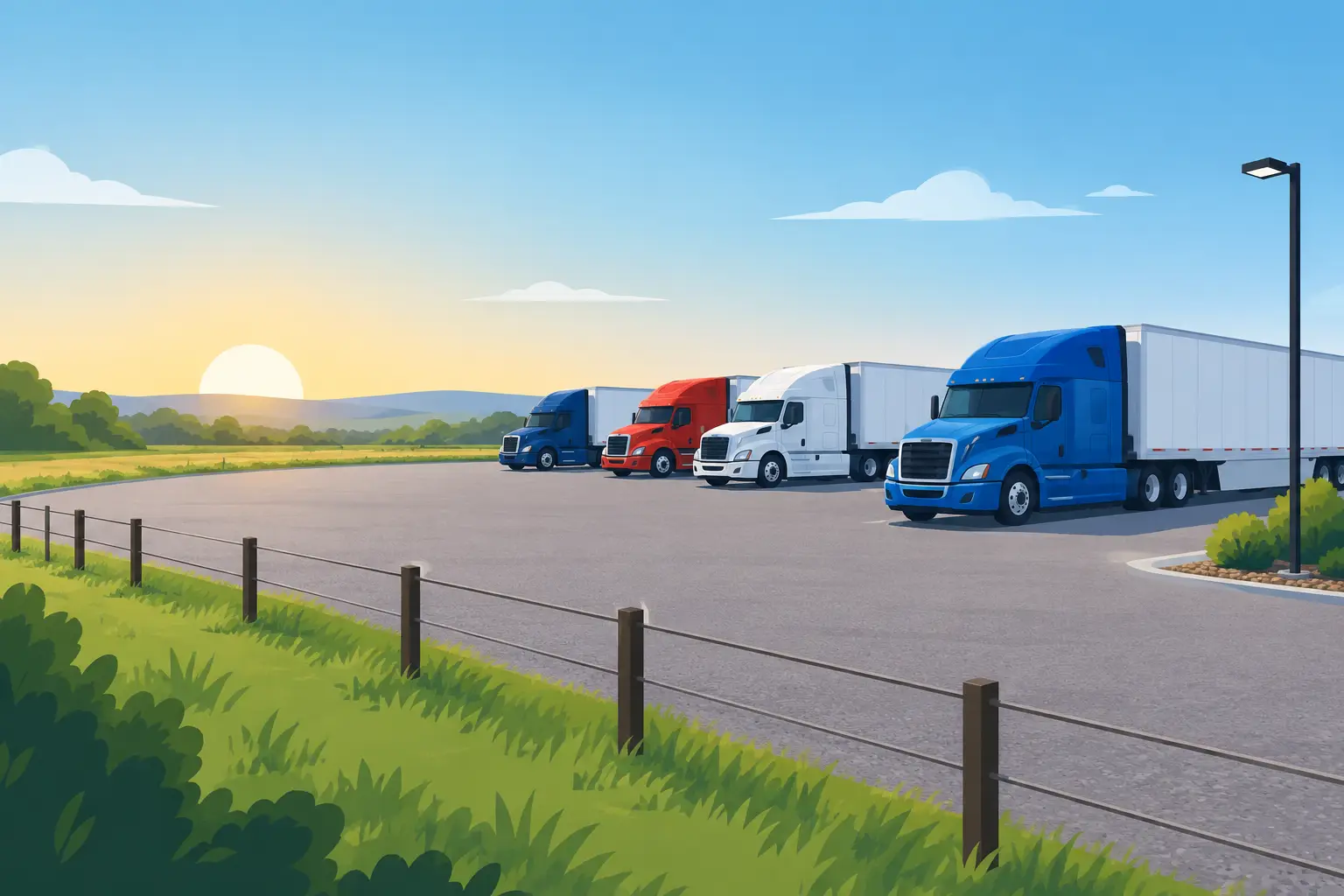
A fenced yard that sits open after 5 p.m. can look like unused overhead. To a driver nearing the end of legal drive time, it can be needed parking. For owners looking to monetize idle land, truck parking can turn suitable excess capacity into recurring income without changing the primary purpose of the property.
The key word is suitable. A truck parking operation depends on physical access, turning room, surface conditions, local routing, and clear boundaries. A few acres near a highway are not automatically a truck-parking site, and a smaller industrial yard with a clean entrance and defined parking rows may be far more usable. The right approach is to assess the ground honestly, set operating limits early, and add demand only where it fits.
Start With the Operating Fit
Truck parking is not simply vehicle storage. A tractor-trailer needs to enter from a truck-appropriate road, make its turns without crossing restricted areas, park without blocking circulation, and leave on schedule. Drivers also need clear arrival instructions. If those basics are uncertain, the property is not ready to be marketed as dependable capacity.
Start with the road approach. Consider whether a full-size truck can legally and safely reach the entrance, including bridge limits, low clearances, residential restrictions, tight intersections, and local no-truck routes. A site may be close to an interstate but still be impractical if the final mile creates a routing problem.
Then look at entrance geometry and internal maneuvering. Gate width, curb cuts, turning radius, parked equipment, utility poles, drainage features, and neighboring traffic all matter. A tractor by itself can work in spaces that will not accommodate a 53-foot trailer. If combined tractor-trailer parking is the goal, test the site against that larger footprint rather than assuming every open area counts as a space.
Surface is the next practical question. Paved lots are often easiest to operate, but compacted gravel or stable industrial ground can work when it drains well and holds up under repeated heavy loads. Soft shoulders, poor drainage, deep potholes, and unmarked low areas can turn a promising site into an ongoing service issue, especially in wet or freezing conditions.
How to Monetize Idle Land With Truck Parking
The strongest owner proposition is not "fill every available inch." It is creating defined capacity that does not interfere with the business already on site. That means deciding what vehicles you will accept, when they may arrive, where they may travel, and which parts of the property remain off-limits.
For example, a business may have room for trailers along one perimeter but need its central yard open for daytime deliveries. Another owner may allow tractors and box trucks but not overnight trailer storage. These are not limitations to apologize for. They are operating rules that protect the property, its existing customers, and its revenue.
A useful site review should establish:
- The usable parking area, with a realistic count based on vehicle type and maneuvering room.
- Entry, exit, and circulation paths that drivers must follow.
- Allowed equipment, such as tractors, trailers, tractor-trailer combinations, or box trucks.
- Hours, gate procedures, lighting conditions, and any escort or check-in requirements.
- Off-limits areas, including tenant spaces, loading zones, equipment storage, drainage areas, and private drives.
- Restrictions created by zoning, leases, insurance requirements, neighborhood rules, or local ordinances.
This level of definition reduces friction later. It also lets a parking operator match requests to the actual site instead of accepting bookings that do not fit the equipment or operating schedule.
Price Capacity Around What the Site Can Handle
Parking rates should reflect the location, equipment type, stay length, security features, and availability, but pricing cannot be separated from operations. A highly accessible paved yard near freight corridors may support daily, monthly, and recurring demand. A basic gravel lot farther from major routes may still have value, particularly for trailer staging or fleet overflow, but its rate and customer profile should match its conditions.
Owners should also decide whether they want flexible daily demand, longer monthly stays, or recurring fleet capacity. Daily parking can create more frequent turnover and more administrative activity. Monthly parking may provide steadier occupancy but can reduce flexibility when an existing customer needs temporary space. A recurring fleet arrangement can be operationally efficient when schedules are predictable, yet it requires confidence that the capacity will remain available.
It depends on what the property needs most. If the goal is incremental income from a consistently unused area, recurring capacity may be the right fit. If the business has seasonal swings or irregular yard use, shorter commitments preserve more control.
Revenue-share partnerships can lower the setup burden for owners because the operator handles demand generation, site presentation, booking coordination, and payment collection. Benchmark Truck Parking, for example, evaluates site conditions and operates as an additional nonexclusive revenue channel, so owners can keep direct customers and other listing relationships. Under its stated structure, owners receive 75% of Benchmark-collected revenue, paid on a 45-day cycle, while Benchmark retains 25%.
That structure is only useful when terms are clear. Before launching, confirm who controls pricing, how cancellations are handled, what notice is required to reduce capacity, and how incidents or rule violations are reported. Incremental revenue should not require giving up practical control of your property.
Build the Site Review Around Real Conditions
A good parking decision can often begin with simple information: one property map, six useful photos, and direct answers about the site. The map should show the entrance, usable area, internal travel path, and off-limits zones. Photos should show the road approach, gate or entrance, parking surface, turning areas, lighting, and any constraints that a driver needs to understand.
Do not rely on aerial imagery alone. A map will not show whether an entrance is blocked by parked trailers at certain hours, whether a gate sticks after rain, or whether a turn requires crossing active loading traffic. Those details determine whether a site works on paper or works every day.
Local demand also deserves a practical look. Sites near interstates, ports, rail terminals, industrial parks, distribution centers, manufacturing clusters, and major metro freight routes are more likely to attract consistent truck demand. But proximity alone is not enough. The site must be reachable without a driver taking an unreasonable detour or encountering route restrictions.
If demand is uncertain, start with a defined section of the property rather than committing the entire yard. A controlled launch lets you validate arrivals, traffic patterns, customer fit, and surface wear. Capacity can be added later when the operation proves it belongs there.
Protect the Property While Adding Revenue
The most common mistake is treating access instructions as an afterthought. Professional drivers need the exact location, accepted vehicle type, arrival window, gate process, and parking assignment before payment and arrival. Vague directions create wrong turns, blocked gates, and calls to people who were never meant to manage parking after hours.
Clear boundaries also protect existing operations. Use visible markings where possible, specify no-parking areas, and keep tenant or employee traffic separate from commercial vehicle circulation. If the property has a gate code, decide how codes are issued and changed. If lighting is limited, say so plainly. If idling, repairs, or drop-and-hook activity are prohibited, make that part of the site rules rather than trying to resolve it after the fact.
Insurance, local approvals, and lease restrictions should be reviewed before accepting vehicles. There is no single answer for every property. Some sites are ready with only basic operating rules; others need landlord approval, zoning confirmation, improved drainage, striping, fencing, or a different access plan. A candid review at the start costs less than correcting a poor fit after trucks are already arriving.
Make the First Capacity Decision Small and Clear
Idle land becomes useful parking when it has a defined purpose, a safe path in and out, and terms that work for the owner. Start with the portion of the property you can protect and manage confidently. Set the vehicle types, hours, boundaries, and availability around your existing operation, then let proven demand guide the next expansion.
The best first step is not a major construction project. It is an honest site review that shows exactly what your ground can support.
More articles · Truck parking locations · List your property