Monthly Trailer Parking Rental for Working Yards
October 9, 2026
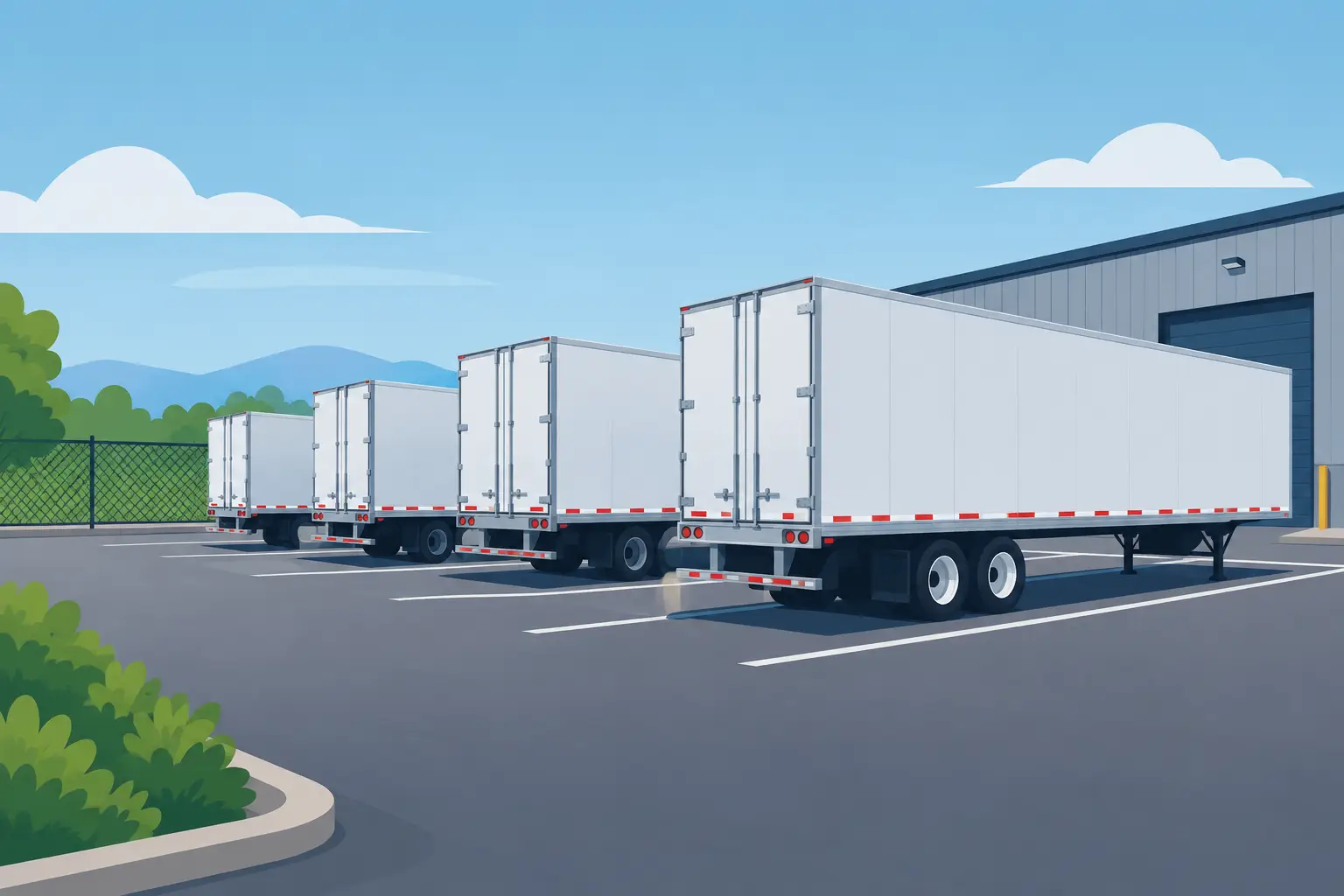
A trailer sitting between loads still needs a place to go. For carriers, that often means searching for secure, accessible space near a route, customer, terminal, or freight corridor. For property owners, monthly trailer parking rental can turn an underused portion of a yard into recurring income without changing the primary purpose of the property.
The fit is not automatic. A few open acres do not necessarily make a workable trailer lot. The site has to support the approach, turns, surface conditions, staging needs, and operating boundaries that commercial equipment requires. The best arrangements start by defining those conditions before the first trailer arrives.
What monthly trailer parking rental actually requires
Monthly parking is different from a one-night stop. A driver booking overnight space may tolerate a tighter site or limited amenities if the location works for a specific rest period. A carrier placing empty or loaded trailers for a month needs predictable access and enough room to retrieve equipment without disrupting other vehicles, tenants, or daily business operations.
That predictability has value. A recurring trailer customer can give an owner more consistent revenue than occasional parking, while the carrier gains a known place to stage equipment. But the longer term also makes unclear rules more costly. If trailers block a delivery lane, drivers use an off-limits entrance, or a customer expects access that was never approved, a seemingly simple arrangement becomes a management problem.
A workable monthly agreement should establish the equipment type, the number of units, the parking area, access hours, payment terms, and any operational restrictions. It should also account for whether equipment is empty, loaded, refrigerated, damaged, or awaiting repair. Those details affect both site fit and risk tolerance.
Start with the physical realities of the site
The first question is not how many acres a property contains. It is how much usable parking capacity remains after accounting for building access, tenant circulation, loading zones, setbacks, drainage, seasonal conditions, and areas that must remain open.
A trailer needs more than a marked rectangle. It needs a truck route to reach that rectangle, enough turning room to back into or pull through a space, and a surface that can carry commercial equipment in the conditions the site will face. An entrance that works for a pickup may fail for a tractor-trailer combination. A gravel area may be acceptable for some operations but may become unreliable after rain, thaw, or repeated heavy traffic.
Road approach matters as much as on-site space. Consider low clearances, weight restrictions, sharp turns, local truck-route limitations, railroad crossings, congested intersections, and whether a driver can enter and exit without backing onto a public road. If access depends on a gate, the process for entry needs to work outside normal office hours if the customer requires it.
Property owners should also be clear about what is not included. Parking trailers does not mean providing repairs, power, loading services, restroom access, overnight driver parking, snow removal beyond the agreed area, or yard labor. Those services can be discussed when appropriate, but they should never be assumed.
Surface, lighting, and drainage are operating issues
A paved lot is often easier to manage, but pavement alone does not determine whether the space is viable. The condition of the surface, drainage patterns, potholes, soft shoulders, and the path from entrance to parking area all matter. Equipment that must cross weak ground to reach an otherwise solid parking pad can still create a problem.
Lighting may be important for visibility, after-hours retrieval, and the property's broader security plan. It is not a promise that the site is guarded. Owners should describe the actual conditions plainly: gated or ungated, lit or unlit, monitored or unmonitored, designated spaces or general yard area. Accurate expectations protect both sides.
Set boundaries before capacity is sold
The most successful trailer parking operations are usually controlled rather than open-ended. A property owner does not need to give up the entire yard or make a sweeping exclusivity commitment to create a useful parking offering. A defined section of the property, with clear entry rules and a known number of spaces, is often the better starting point.
Physical boundaries help. Cones, striping, signs, fencing, marked rows, or a simple site map can show drivers where to go and where not to go. Operational boundaries matter too. Specify whether trailers may be dropped only, whether tractors may remain attached, whether drivers may stage during certain hours, and whether loaded trailers are accepted.
It also helps to preserve existing customers and operating relationships. A property may already rent yard space directly, use another listing source, or hold capacity for seasonal business needs. Monthly trailer parking should function as an additional revenue channel where it fits, not force an owner to abandon arrangements that already work.
For owners with changing operations, flexibility is valuable. Capacity may be available after a tenant moves, during a construction pause, or until a planned expansion begins. In those cases, the duration and termination terms should be realistic. It is better to offer a defined amount of space for a defined period than to overpromise capacity that the property will soon need back.
Price for the actual operating fit
There is no single monthly rate for trailer parking. Location influences demand, particularly near industrial centers, intermodal activity, major freight lanes, manufacturers, warehouses, and distribution routes. But local demand is only part of the equation. A well-located site with difficult entrance geometry may command less than a slightly less central site with clean truck access and dependable circulation.
Pricing should reflect the equipment footprint and the operating burden. A 53-foot trailer occupies more than its physical stall once turning and retrieval room are considered. A customer needing unrestricted access at all hours may require more planning than one that retrieves equipment during scheduled windows. A fenced, designated area may justify a different rate than open, unassigned yard space.
Owners should avoid treating every unit as interchangeable. Box trucks, straight trucks, tractors, trailers, and tractor-trailer combinations need different amounts of room. The right rate follows the right use case.
A practical review process for property owners
Before offering monthly trailer parking rental, gather enough information to make a real site decision. This does not require a full development plan. It requires a clear view of the property and how commercial vehicles would move through it.
Start with a map showing the entrance, internal travel path, usable parking area, buildings, gates, and off-limits zones. Then collect current photos from the road approach, entrance, turning areas, parking surface, and any relevant obstacles. If the space is seasonal or conditions change after rain or snow, say so upfront.
Next, define the operational fit. Estimate how many trailers can park without blocking circulation. Identify the equipment types that can be accommodated. Decide whether access is 24/7, scheduled, or limited to business hours. Confirm what rules apply to gates, speed, idling, trash, damaged equipment, and unauthorized use of other parts of the property.
A marketplace partner can help evaluate demand and site suitability, but it should not replace owner judgment about the property. The owner knows which lanes must stay open, which tenant relationships need protection, and which areas create unnecessary risk. Benchmark Truck Parking uses site information, access conditions, usable space, restrictions, and local demand to determine whether a property is a practical fit before a parking arrangement moves forward.
What drivers and fleets should confirm
For drivers and fleet managers, the location name alone is not enough. Confirm the exact address, approved equipment type, dates, number of units, entry instructions, and whether the site can support the intended arrival and retrieval schedule. A trailer-only space may not have room for a tractor to wait or turn around. A site suitable for an empty trailer may not accept loaded equipment.
Recurring fleet capacity deserves the same care. A fleet may need five trailers this month and 12 during peak season. It may need early-morning access, weekend retrieval, or space close to a specific customer. Those requirements should be discussed before payment, not discovered at the gate.
Build a parking arrangement that stays workable
Monthly trailer parking is most valuable when it removes friction instead of moving it onto the property owner. Clear site information, realistic capacity, controlled access, and direct expectations do more for a parking operation than broad claims about available land.
If your property has unused ground, start small if needed. Mark the usable area, protect the parts of the yard that support your business, and only accept equipment your site can handle safely. The right arrangement leaves the property more productive without making daily operations harder.
More articles · Truck parking locations · List your property