Truck Parking Site Access Requirements That Work Best
October 3, 2026
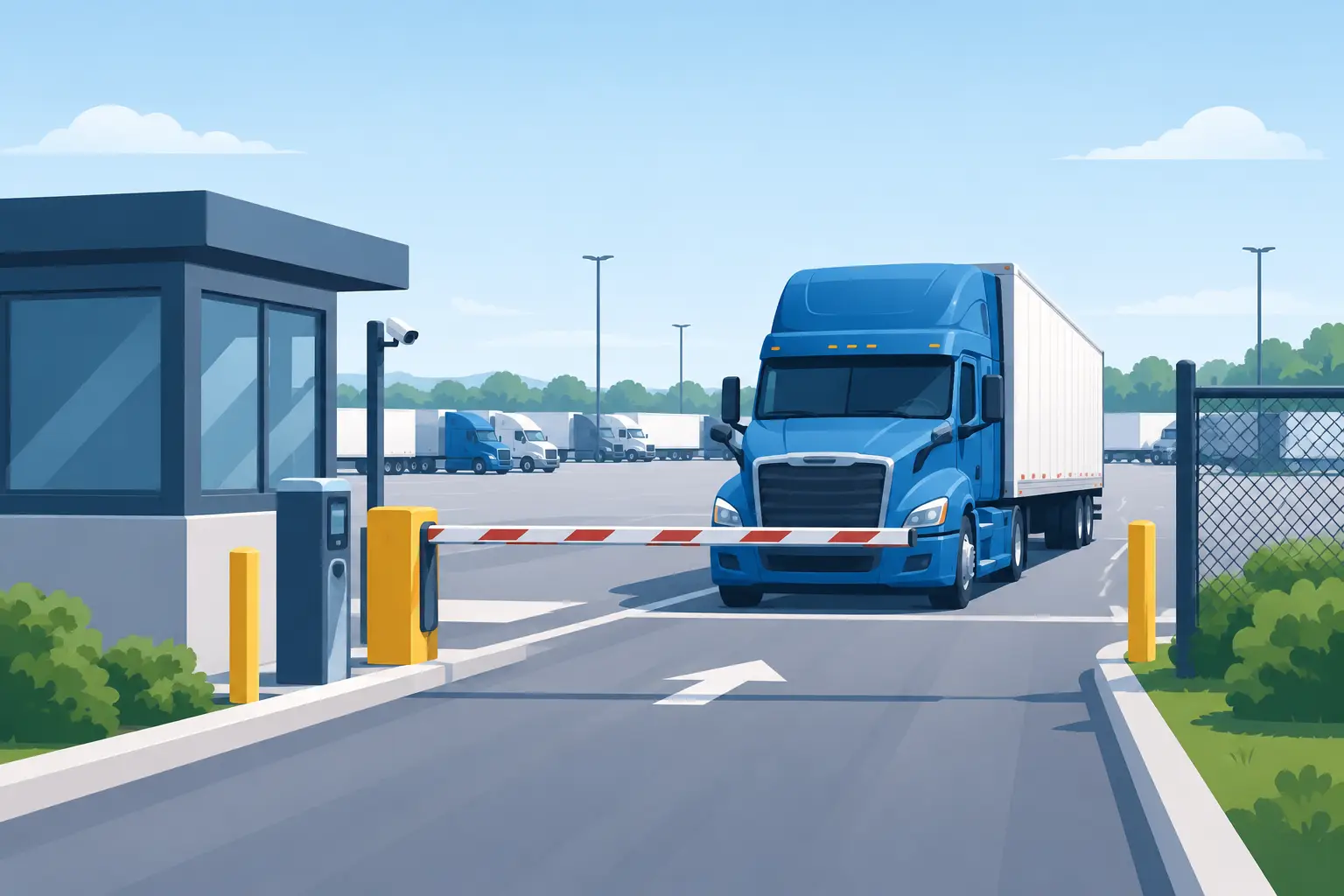
A truck can fit on a property and still be unable to use it. That is the central issue behind truck parking site access requirements. Aerial images may show open pavement or usable ground, but the real decision depends on how a tractor, trailer, or combined unit reaches the space, turns into it, parks, and exits without disrupting your operation.
For property owners, access is what separates usable capacity from a costly headache. For drivers and fleets, it determines whether a reserved space is practical after hours, compatible with the vehicle, and reliable for the next dispatch. The best sites do not need to be perfect. They need a clear, repeatable operating path.
Truck Parking Site Access Requirements Start at the Road
The review begins before a truck reaches your gate. Consider the approach from the nearest truck-legal route, not simply the closest highway or main road. A site may be close to freight demand but still be a poor fit if the last mile includes tight neighborhood streets, low clearances, weight-restricted roads, sharp turns, or local rules that make commercial vehicle traffic impractical.
The road approach should allow the intended vehicle type to arrive without improvised routing. A box truck has different needs than a sleeper cab pulling a 53-foot trailer. A yard that works well for tractors may not work for full combinations. Be specific about what you can accommodate rather than assuming all commercial vehicles operate the same way.
Road conditions matter as well. Narrow shoulders, blind turns, soft edges, steep grades, and congested intersections can turn an otherwise workable entrance into a problem during peak traffic or bad weather. If the access route requires drivers to back into a public road, cross opposing traffic, or make an uncertain turn, that condition needs serious review.
Match access to the vehicles you want to serve
There is no single access standard that fits every parking location. The practical question is: what equipment can use this site safely and consistently?
A location intended for daily tractor parking may have a smaller footprint than one designed for recurring trailer storage. A fleet with predictable arrivals may be able to work within tighter operating windows than a site receiving individual drivers at varied times. Some properties can support box trucks and straight trucks but should not be marketed for long tractor-trailer combinations.
Clear limits protect everyone. If only certain parking rows, gate hours, or vehicle types work, establish that boundary upfront. Capacity is not just the number of spaces visible on a map. It is the number of spaces that can be used without creating avoidable conflicts.
Entrance Geometry Determines Whether a Site Is Usable
A wide lot beyond a narrow gate is not functional truck parking. The entrance has to accommodate the approach, turning radius, gate position, and trailer swing required for the equipment you expect.
Look at the full entrance sequence. Is there enough room for a truck to line up before making the turn? Can a driver enter from either direction, or only one? Does the gate sit far enough back from the road for a vehicle to wait without blocking traffic? Are there signs, posts, curbs, utility poles, landscaping, parked cars, or drainage features that reduce usable width?
Gate operations deserve the same attention. A manually operated gate may be reasonable for a daytime yard with on-site staff. It may not fit overnight parking, late arrivals, or drivers working under tight hours-of-service limits. If access is controlled by a code, app, call box, or lock, the process must be dependable and communicated before arrival.
A good entrance also accounts for exits. Trucks need room to leave without difficult backing maneuvers or conflicts with incoming traffic. If entry and exit share a constrained drive, staggered arrivals, directional signage, or a defined one-way pattern may make the difference between workable and unworkable.
Evaluate the On-Site Truck Path, Not Just the Parking Area
Once a vehicle enters, it needs a continuous route to its assigned space. This is where many sites lose usable capacity. Buildings, parked equipment, dumpsters, stored materials, employee vehicles, loading activity, and internal islands can restrict movement more than the lot size suggests.
Walk or drive the path with truck movement in mind. Identify where a driver will turn, straighten out, reverse if needed, and pass another vehicle. Pay attention to corners, overhead obstructions, uneven transitions, and areas that become blocked during normal business operations.
The right layout depends on the site. Pull-through spaces reduce backing and are easier for short stays, but they require more linear room. Back-in parking can use space efficiently, but it needs adequate aisle width and a clear setup area. Trailer storage may tolerate a different layout than driver parking, especially if trailers are dropped and retrieved on a planned schedule.
Do not count marginal spaces simply because a truck might fit there on a quiet day. Reliable capacity is more valuable than a larger number that only works when the lot is empty. Benchmark Truck Parking reviews maneuverability and usable space as operating conditions, not as a simple acreage calculation.
Surface, drainage, and grade affect access every day
A hard, stable parking surface is often the simplest choice, but usable ground can vary by climate, season, vehicle weight, and traffic frequency. Gravel may work well when it is properly built and maintained. Dirt or grass may be acceptable for limited, dry-weather use, but it can quickly become unsuitable after rain, thaw, or repeated heavy axle loads.
Drainage is part of access. Standing water can hide ruts, soften shoulders, and limit where drivers can turn. Steep grades may create traction issues, especially near gates or parking rows. A site does not need a major construction project to be considered, but its actual surface condition should match the intended use.
Be candid about seasonal limits. If a portion of the property should close after heavy rain or during winter conditions, that can be managed as long as it is known in advance. Trying to offer all-weather capacity from a surface that cannot support it creates a bad experience for both owners and drivers.
Set Boundaries Before You Offer Parking
Truck access is also about protecting the parts of your property that should remain private, active, or off-limits. Many workable sites share space with an operating business, tenant activity, equipment storage, or employee parking. That does not disqualify the property. It makes boundaries essential.
Mark truck routes, parking zones, turnaround areas, restrooms if available, and any restricted areas. Drivers should not have to guess where to park or whether they can use a loading dock, fuel island, building entrance, or neighboring lot. Simple signs and clear instructions often prevent more problems than complicated site rules.
Decide how arrivals will work after hours, who handles an access issue, and what happens if a vehicle is parked outside its assigned area. If your operation requires quiet periods, limited idling, or no maintenance activity, say so plainly. A practical parking program respects the property owner's existing business first.
Nonexclusive capacity can be especially useful here. You can preserve direct customers and current listing relationships while adding another channel for the spaces and periods you are prepared to offer. The goal is not to turn every yard into a full-time truck stop. It is to put suitable idle capacity to work within terms you can manage.
Build a Site Review Around Real Conditions
The fastest way to reach a real decision is to provide a map, current photos, and straightforward operating details. Show the road approach, entrance, gates, internal drive lanes, parking area, and off-limits zones. Photos taken from a truck's likely approach are more useful than distant property images alone.
Include the details that change the answer: vehicle types allowed, approximate number of usable spaces, surface type, hours of access, lighting, security features, gate controls, and known restrictions. If a driver must enter from a particular direction or call before arrival, that is not a minor detail. It is part of the site access plan.
A site review should also consider local rules, lease terms, zoning, and any restrictions imposed by a lender, association, tenant agreement, or insurance requirement. Physical access may be strong while the permitted use is not. Confirming those conditions early avoids spending time on capacity that cannot be offered.
The right truck parking site is rarely the one with the most open ground. It is the one where the route is clear, the entrance works, the surface holds up, and your boundaries remain intact. Start with how a truck actually moves through the property, and the value of your available capacity becomes much easier to judge.
More articles · Truck parking locations · List your property