Truck Parking Site Restrictions Checklist
October 5, 2026
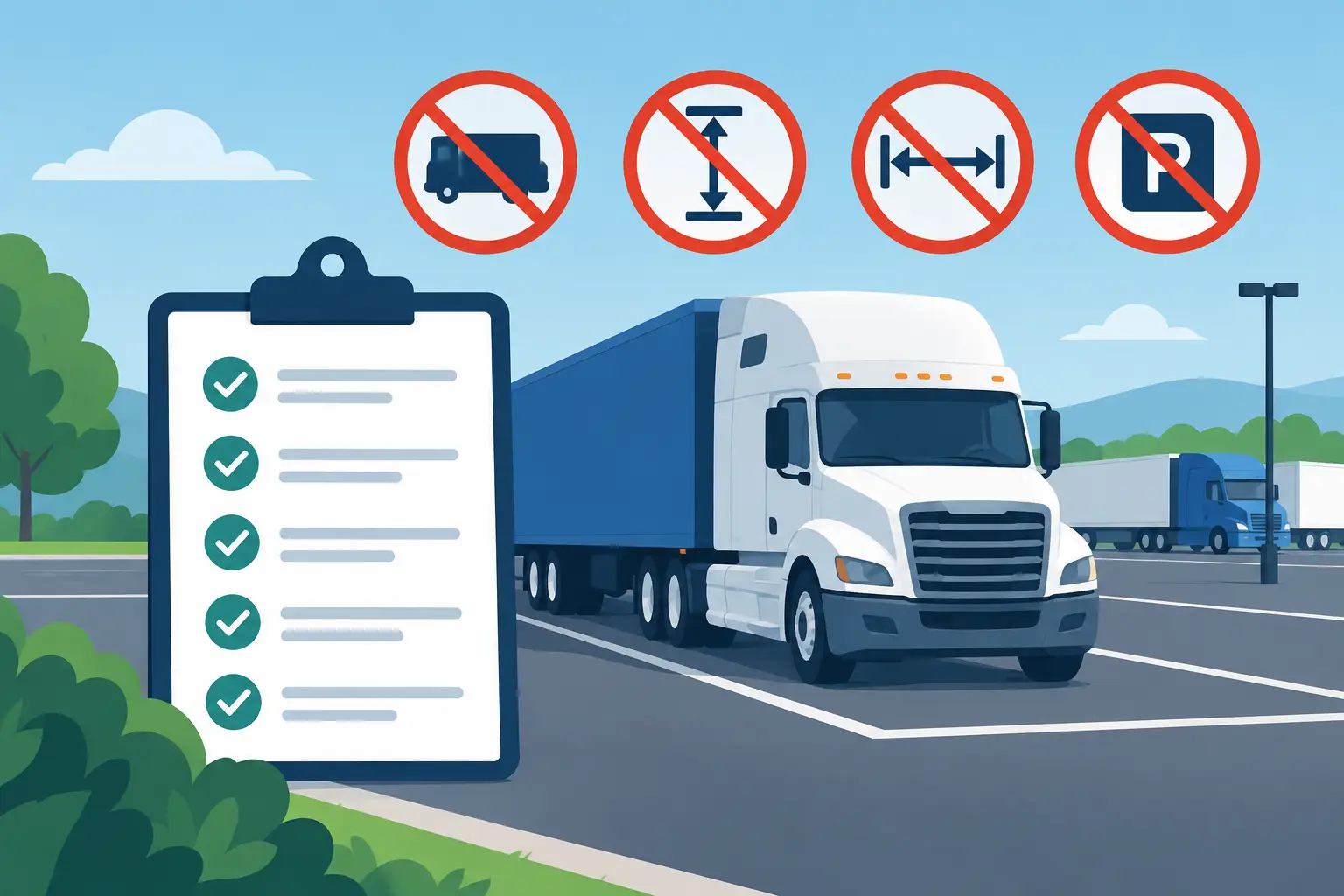
A site can have plenty of open ground and still be a poor fit for commercial truck parking. The difference usually comes down to restrictions: where trucks may travel, which areas must stay clear, what hours work, and whether the site can handle the vehicle types being requested. This truck parking site restrictions checklist helps property owners turn those details into clear operating boundaries before a truck arrives.
Restrictions are not a reason to rule out a property. They are how an owner protects the parts of the property that matter most. A fenced yard may have room for trailers but no overnight idling. An industrial lot may accommodate tractors during the week but need certain rows available for employees each morning. A good parking arrangement works around those realities instead of asking the owner to change them.
Start With the Restrictions That Cannot Move
Begin with the non-negotiable conditions. These are the rules that apply regardless of demand, rate, or length of stay. They may come from a lease, zoning requirement, insurance policy, customer agreement, neighbor concern, or the simple fact that your operation needs the space.
Document whether commercial vehicles are permitted on the property and which types are acceptable. A box truck, day cab, sleeper tractor, empty trailer, loaded trailer, and tractor-trailer combination do not have the same footprint, turning needs, or operating impact. If the site only works for trailers, say so. If it can accept tractors but not combinations, make that boundary explicit.
Also identify any conditions that limit use of the property. Examples include a tenant's reserved parking area, an active loading zone, fire lanes, drainage areas, equipment storage, utility access, and spaces used for seasonal inventory. These restrictions should be marked on a site map, not left to a verbal description. One map and a few clear photos can prevent a long list of avoidable questions later.
Truck Parking Site Restrictions Checklist
1. Access and approach
Truck access starts before the gate. Review the route from the nearest truck-friendly road to the entrance. Are there low clearances, weight limits, tight corners, residential streets, school zones, or local truck-route restrictions? A site may look workable from an aerial view but fail at the final turn.
At the entrance, assess gate width, curb geometry, driveway slope, and sightlines. A tractor may enter comfortably while a 53-foot trailer cannot make the turn without crossing a landscaped area, opposing lane, or neighboring parcel. If arrivals must use a specific gate or approach direction, include that in the site instructions.
Consider when the entrance is available. Gates shared with an operating business can create conflicts during shift changes, delivery windows, or customer traffic peaks. Controlled arrival hours are often a practical solution when 24-hour access would disrupt the property.
2. Vehicle and parking limits
Set a clear limit for the vehicles the site can safely accept. Do not describe capacity as simply “truck parking” if the usable space is more specific. State whether the property can handle tractors, trailers, straight trucks, bobtails, or tractor-trailer combinations. Note maximum trailer length if a particular row, aisle, or turnaround has a constraint.
Parking layout matters as much as total acreage. Trucks need room to pull into a space, back out, turn around, and leave without moving other vehicles. A compacted gravel yard may have enough square footage for 20 trailers on paper but only enough maneuvering room for 12 without creating congestion.
Be direct about loaded equipment. Some owners are comfortable with empty trailers but prefer not to host loaded units, refrigerated trailers, hazardous materials, or equipment carrying high-value freight. Those are operating decisions, not minor details. Defining them early protects both the property and the driver.
3. Surface, drainage, and seasonal conditions
The parking surface needs to match the weight and movement of the equipment. Paved lots, stabilized gravel, compacted stone, and firm industrial yard surfaces can all work, depending on site conditions and vehicle use. Soft ground, deteriorated pavement, steep grades, standing water, and poorly defined edges can create damage or recovery issues.
Walk the site after rain if possible. Drainage problems do not always show up in dry weather. Look for low spots, rutting, washouts, loose gravel, and areas where a trailer landing gear, tire, or tractor drive axle could sink.
Seasonality deserves the same attention. Snow storage, freeze-thaw damage, mud, harvest activity, construction staging, and seasonal business inventory can change usable capacity. It may be better to offer fewer spaces year-round than to advertise capacity that disappears for several months.
4. Hours, noise, and on-site conduct
Decide whether the property supports overnight parking, daytime staging, or both. Overnight stays can be valuable for drivers and fleets, but they may bring idling, early departures, late arrivals, and more frequent gate activity. A site near homes, offices, or a business with early customer traffic may need tighter hours.
Set expectations for idling, repairs, washing, fueling, trash, and personal vehicle storage. Most parking properties are not maintenance yards. If repairs, trailer drops, or equipment transfers are not permitted, state that plainly. The same applies to parking outside assigned areas or blocking internal roads.
Lighting and visibility should be reviewed honestly. Lighting can improve orientation and security, but it does not need to be presented as something it is not. If parking is in a defined, unlit portion of the yard, that condition should be known before booking. Clear information creates better-fit requests and fewer disputes.
5. Security, gates, and access control
Describe how access works in real operating terms. Is the entrance open, locked, staffed, controlled by a code, or managed through an appointment process? Can a driver enter independently after confirmation? Is there a separate exit? Are there areas beyond a gate that remain off limits?
Owners should also determine what information is needed before granting access. For recurring fleet parking, that may include unit numbers, authorized drivers, arrival schedules, and a point of contact for exceptions. For shorter stays, vehicle type, dates, and expected arrival time may be enough.
Security expectations should be realistic. A fenced property is not automatically a monitored facility, and a camera at an entrance does not mean every parking row is under continuous observation. State the actual condition of the site and avoid assumptions about services that are not provided.
6. Capacity reserved for your own operation
Idle ground is rarely permanently idle. Many owners need flexibility for tenant growth, a new contract, equipment purchases, or temporary project work. Identify how much capacity can be offered consistently and how much must remain available for your business.
This is where nonexclusive participation can be useful. Adding truck parking as an additional revenue channel does not require an owner to give up direct customers or existing third-party listings. The key is to avoid promising the same spaces twice. Keep a current count of available spaces, reserve the areas your operation needs first, and update availability when conditions change.
For recurring fleet demand, build in a review point. A monthly arrangement may be a strong fit when the fleet's schedule and vehicle count are stable. If your own yard needs are likely to change soon, shorter commitments or a smaller initial allocation may be the better operational choice.
Put the Rules Into a Site-Ready Record
A workable restriction plan should be easy for someone else to follow without guessing. Mark the parking area, entrance, exit, truck path, turnaround space, and all off-limits zones on a map. Add photos from the road approach, gate, interior turns, parking surface, and any condition that could affect a large vehicle.
Then write the rules in plain language: permitted vehicle types, approved arrival hours, gate procedure, assigned parking area, idling policy, and prohibited activities. If a restriction exists because of a tenant, active operation, or safety requirement, include it. Specificity is more useful than trying to make a site sound broadly available.
Benchmark Truck Parking reviews these practical conditions with owners because parking capacity only has value when it can be used reliably. Road approach, entrance geometry, maneuverability, usable space, and property boundaries all affect whether a driver or fleet request is a real fit.
The strongest sites are not necessarily the largest or newest. They are the sites where an owner can say exactly where a truck goes, when it can arrive, what it may park, and what must stay protected. Put those answers on paper before launch, and the parking operation has a much better chance of staying useful revenue instead of becoming a daily exception.
More articles · Truck parking locations · List your property