Truck Stop Parking: What Property Owners Can Offer
October 26, 2026
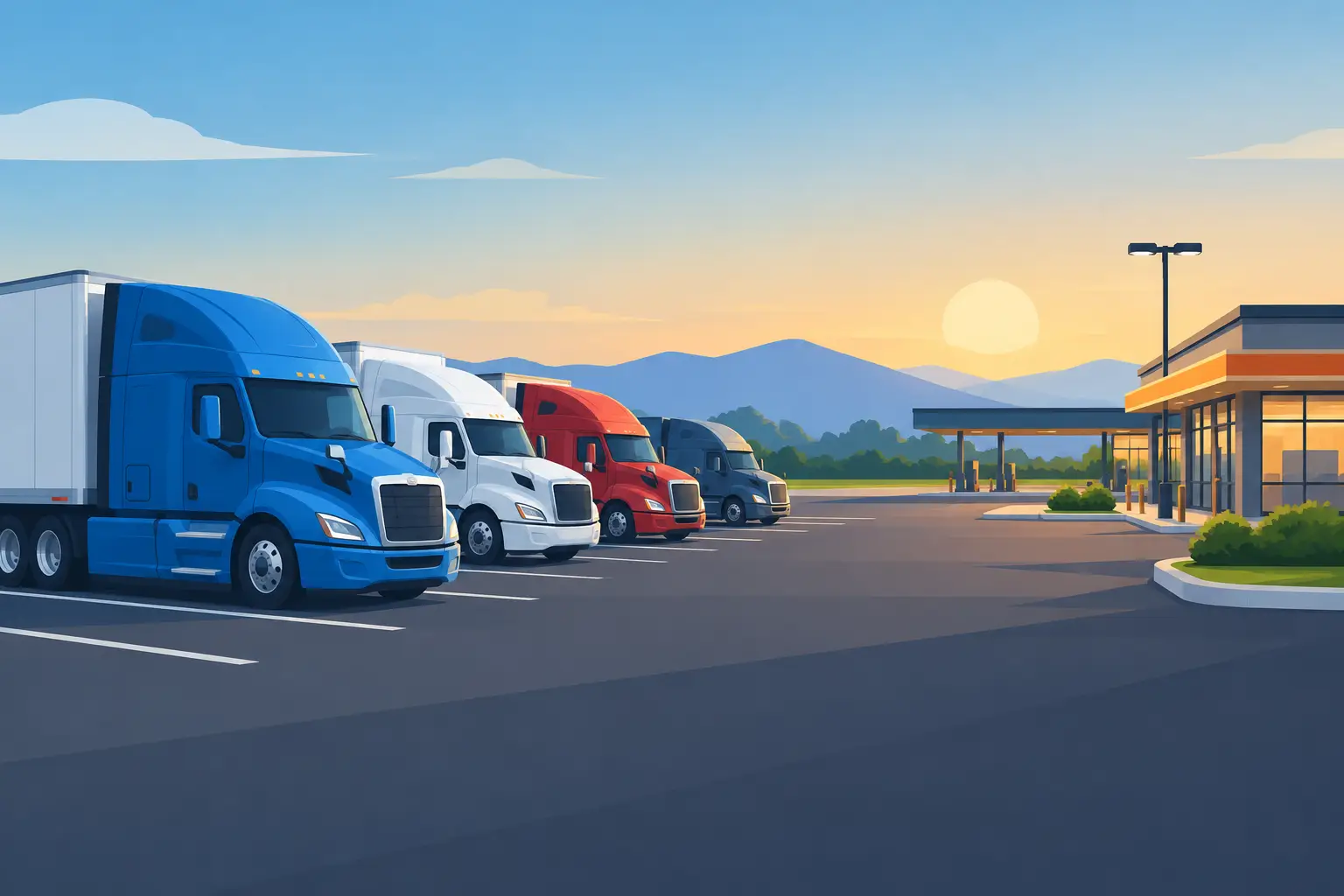
A driver running out of legal hours does not need a broad promise of parking nearby. They need to know whether their tractor-trailer can enter, turn, park, remain overnight, and leave on schedule. That is where the difference between a traditional truck stop and a workable commercial parking site becomes clear.
For property owners, the opportunity is not necessarily to build fuel islands, restaurants, showers, or a full-service travel center. In many markets, the practical need is simpler: safe, vehicle-compatible space for commercial trucks. An underused yard, paved lot, stabilized ground, or available industrial acreage may have value if the access and operating conditions are right.
A Truck Stop Is a Service Model, Not Just a Parking Lot
The traditional truck stop combines several functions. It may offer fuel, food, convenience items, maintenance, restrooms, showers, and truck parking. Those services matter, especially for long-haul drivers. They also require substantial investment, staffing, permits, utility capacity, and ongoing operations.
Truck parking solves a narrower but urgent problem. A driver may need a place to stage before a morning delivery, wait for an appointment, take a required break, drop a trailer, or hold equipment between dispatches. A fleet may need recurring capacity near a terminal, customer, port, warehouse cluster, or highway route.
That distinction matters for landowners. A site does not need to operate like a truck stop to serve commercial vehicles well. It does need to be honest about what it can support. A basic site with reliable access, defined spaces, clear rules, and accurate instructions can be more useful than a larger property with uncertain entry conditions.
What Makes a Site Usable for Truck Parking
Usable space is not measured only in acres or the number of visible open spots. A truck and trailer need room to approach, make turns, straighten out, park without blocking circulation, and exit without relying on a neighbor's driveway or an unapproved route.
The first question is road approach. Can a commercial vehicle reach the property using roads that are appropriate for truck traffic? A location near freight activity may still be a poor fit if the final approach includes restrictive bridges, tight residential streets, low clearances, difficult intersections, or local restrictions.
Entrance geometry comes next. A gate opening that works for a pickup may not work for a 53-foot trailer. Curbs, medians, poles, drainage structures, signs, and sharp turns all affect whether a driver can enter without risk. The same is true inside the property. A lot can look open from above but become difficult once parked trailers, storage, buildings, or equipment reduce the turning area.
Surface condition also affects the operating fit. Paved parking is often the simplest option, but compacted and well-maintained ground can work in certain settings. The practical question is whether the surface can handle truck weight in expected weather without rutting, getting soft, or creating a recovery problem. Drainage, snow management, dust, mud, and seasonal use restrictions should be addressed before capacity is offered.
Lighting, security measures, fencing, gates, and cameras can improve a site's appeal, but they are not interchangeable with basic access. A well-lit lot that a truck cannot safely enter is not viable parking. Conversely, a straightforward yard with clear boundaries and dependable instructions may be a good fit for drivers who prioritize location and vehicle compatibility.
Boundaries Make Parking Easier to Operate
Property owners do not need to make every square foot available. In fact, truck parking works better when the operating area is clearly defined. Mark the spaces or zone intended for commercial vehicles, identify entry and exit points, and keep off-limits areas visible in site instructions.
That may include employee parking, loading docks, equipment storage, tenant areas, private drives, drainage zones, or portions of the property that cannot carry heavy vehicles. Clear boundaries protect the owner's existing operation and give drivers fewer decisions to make after arrival.
A workable plan also identifies the vehicle types that fit. Tractor-only parking, trailer storage, box trucks, and tractor-trailer combinations do not use space in the same way. A property that can handle overnight tractors may not have enough room for trailers to maneuver independently. There is no advantage in advertising capacity that creates conflict on the ground.
The Right Parking Demand Depends on Location
Not every property should pursue the same type of truck parking. A site near an industrial corridor may be well suited to recurring fleet parking. One near a distribution center may serve drivers staging around appointment times. Land near a major route can be useful for short stays, provided trucks can reach it without operational friction.
In Illinois, Indiana, Wisconsin, Iowa, Kentucky, Texas, New York, Georgia, and Florida, freight patterns vary significantly by metro area, warehouse concentration, agricultural activity, manufacturing, and highway access. Demand should be evaluated at the property level rather than assumed from a state map. Two sites ten miles apart can have very different value if one has a direct truck route and the other does not.
This is also where trade-offs matter. A site close to demand may command stronger interest but require tighter controls because of surrounding uses. A larger rural property may have more physical room but less consistent demand. Some owners prefer daily or short-term use; others want recurring monthly capacity that is easier to plan around. The right operating model depends on the site's condition and the owner's tolerance for activity, not on a one-size-fits-all parking formula.
Add Capacity Without Replacing Existing Business
For many owners, the concern is not whether unused ground could earn revenue. It is whether opening that space creates a new business they have to staff, market, manage, or defend against existing relationships.
A practical parking arrangement should preserve the owner's control. That means setting available areas, vehicle types, access windows, site rules, and any restrictions before bookings are accepted. It also means retaining the freedom to keep direct customers and existing third-party listings. Additional demand should function as an added channel, not an all-or-nothing platform change.
At Benchmark Truck Parking, site review starts with the physical facts: a map, photos, access details, usable area, and operating boundaries. The goal is not to force every property into a standardized listing. It is to determine whether the location has a safe, commercially sensible fit for truck parking and what capacity can be offered without interfering with the property owner's core use.
For drivers and fleets, exact confirmation matters just as much. Parking should be matched to dates, vehicle configuration, length of stay, and access needs. A vague location pin is not enough when a driver is approaching at night with limited available hours. Confirmed instructions, pricing, and site expectations reduce avoidable confusion for everyone involved.
What to Review Before Offering a Truck Stop Alternative
Before treating a property as commercial truck parking, review the operating conditions with the same discipline used for any other revenue-producing use. The questions are straightforward, but the answers should be specific.
Start with local rules, lease obligations, zoning, insurance requirements, and any private restrictions that affect commercial vehicles, overnight use, trailer storage, or customer access. Then walk the route from the public road through the entrance and into the proposed parking area. Look for pinch points rather than relying only on satellite imagery.
Take current photos from the driver's perspective where possible. Show the entrance, gate, turns, parking surface, lighting, and any areas that are unavailable. A property review becomes more accurate when the physical layout is documented early, before a truck arrives and exposes an issue that could have been avoided.
Finally, decide what “available” actually means. Is the space open every day or only on certain nights? Can a driver arrive after hours? Are trailers allowed without a tractor? Is the site intended for one-time stays, monthly parking, or recurring fleet use? Clear answers create a better fit than broad availability claims.
The strongest truck parking sites are rarely the ones that promise everything. They are the ones that state their capacity plainly, protect the property’s boundaries, and give a driver enough certainty to arrive, park, and get back on the road without wasted time.
More articles · Truck parking locations · List your property