Yard Parking Rules for Commercial Truck Sites
November 1, 2026
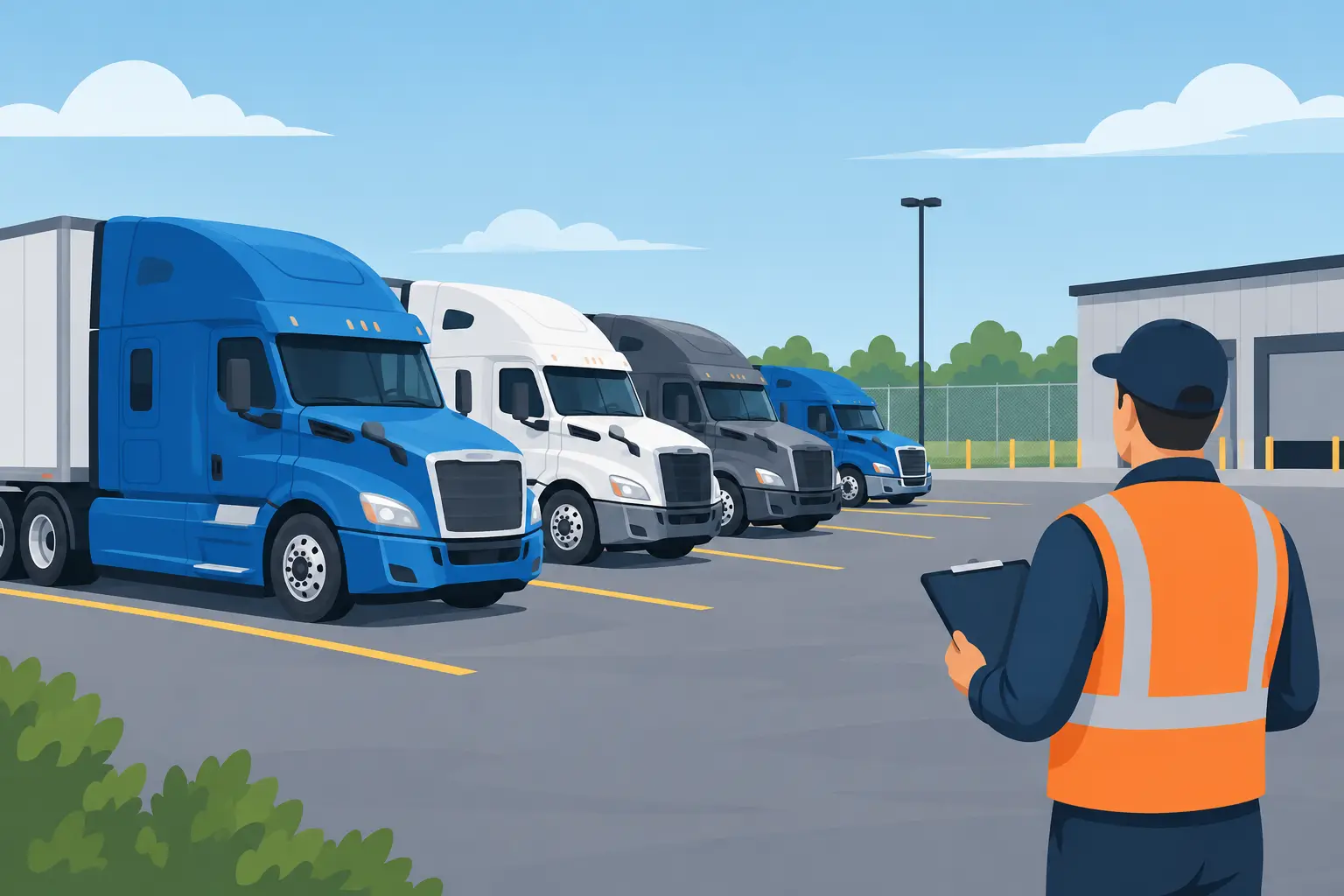
A truck can fit on a property and still be the wrong fit for the yard. That is why yard parking rules matter. Clear rules protect the owner’s daily operation, give drivers usable instructions, and make extra capacity easier to manage without turning an active property into an uncontrolled truck stop.
For commercial property owners, the goal is not to write a long rulebook. The goal is to establish operating boundaries that match the real site: where trucks enter, what they can park, when they can arrive, and what remains off limits. Good rules begin with a good site decision.
Yard Parking Rules Start With the Physical Site
Before setting rates, deciding on a monthly arrangement, or accepting a parking request, look at how a truck actually moves through the property. A tractor, trailer, and tractor-trailer combination need more than open square footage. They need a workable approach from the road, enough entrance width, turning room, a reliable parking surface, and a path that does not conflict with employees, customers, loading activity, or stored materials.
The first rule should be simple: only vehicles that the site can safely accommodate may use the site. That means defining whether the yard accepts tractors, trailers, straight trucks, box trucks, or combined units. A lot that works well for trailers may not have the turn radius for a long tractor-trailer. A paved industrial lot may be suitable in dry weather but not for repeated heavy traffic if the designated area is unpaved or soft.
Access instructions need the same level of care. Drivers should know the approved entrance, gate procedure, route through the property, and assigned parking area before arrival. “Park in the back” is not an instruction if the back of the property includes multiple drive lanes, active docks, or restricted storage. A simple map, marked access point, and site photos can eliminate avoidable calls and wrong turns.
Set boundaries before accepting vehicles
Most parking issues come from unclear edges. A property may have space for ten trailers, but only seven spaces are practical once fire lanes, loading doors, customer parking, dumpsters, gates, drainage areas, and internal traffic are respected.
Mark the areas that are available and the areas that are not. Off-limits zones may include loading docks, tenant spaces, private drives, fuel areas, equipment storage, employee lots, landscaped areas, and any path needed for emergency access. If a driver must not idle near offices or residential neighbors, state that directly. If a gate must remain closed after entry, make that an operating requirement rather than an assumption.
Physical markers help when they match the rule. Painted lines, cones, signs, numbered spaces, and clearly identified gates reduce confusion. They are especially useful at sites with recurring parking, nighttime arrivals, or more than one type of commercial vehicle.
Build Rules Around Real Operating Hours
A parking arrangement should support the property’s business first. If trucks arrive while employees are receiving deliveries, moving equipment, or opening a gate for customers, parking can quickly become an operational burden. Arrival and departure windows are one of the most useful controls an owner can set.
Some sites can accept 24-hour access because the parking area is separated from active operations and the gate process is straightforward. Others work better with scheduled access, daytime-only arrivals, or a requirement that drivers call before entering. Neither approach is universally better. The right rule depends on staffing, gate controls, neighbors, lighting, and how much separation exists between parking and the core business.
Consider the full stay, not just the arrival. A trailer parked for a week may be easy to place but difficult to retrieve if it is blocked by other vehicles. A monthly customer may need dependable access at 4:00 a.m., while a short-term driver may only need an overnight space. Rules should reflect the parking product being offered rather than treating every request the same.
For recurring fleet capacity, it is usually worth setting a release process. If a fleet no longer needs reserved spaces, how much notice is required? If a vehicle has been left beyond the approved stay, who is contacted? These details protect both the site’s usable capacity and the relationship with the customer.
Cover Safety, Conduct, and Site Condition
Parking rules should make clear that drivers are responsible for safe operation on the property. That includes observing posted speed limits, following designated traffic flow, avoiding blocked lanes, and keeping vehicles within assigned spaces. The property owner should not have to negotiate these basics every time a truck arrives.
A practical set of conduct rules often addresses four areas:
- No repairs, maintenance work, washing, or fluid disposal unless the property specifically allows it.
- No dumping, abandoned equipment, loose trash, or storage outside the assigned vehicle footprint.
- No blocking of gates, fire lanes, docks, drive aisles, or other designated access routes.
- No unauthorized guests, vehicle swaps, or use of areas outside the confirmed parking assignment.
The details should fit the site. Some industrial yards may permit limited trailer checks or tractor staging. Others need a strict no-maintenance rule because of lease terms, environmental exposure, or proximity to neighboring businesses. If the ground has weight limits, drainage concerns, soft shoulders, or seasonal restrictions, put those conditions in writing and adjust availability when needed.
Lighting and security deserve practical attention, too. Lighting improves visibility but does not guarantee security. Fencing and gates add control but do not replace clear access procedures. Owners should describe what the site has, avoid overpromising, and require drivers to secure their own vehicles and cargo. If a gate code is used, establish how it is issued, when it changes, and who may receive it.
Check Local Requirements Before Launch
Property-level yard parking rules do not replace local zoning, land-use, fire, environmental, lease, or insurance requirements. A site may have usable ground and strong truck demand but still face restrictions on commercial vehicle storage, overnight parking, noise, signage, access, or the number of vehicles allowed.
This is where owners should separate operational fit from legal permission. Operational fit asks whether trucks can enter, turn, park, and leave safely. Legal permission asks whether the use is allowed at that address and under what conditions. Both need to work.
Review existing leases, lender requirements, association rules, and municipal regulations before opening capacity. If the property is tenant-occupied, confirm that parking will not interfere with tenant rights or promised access. If trucks will use a shared drive or private road, make sure the agreement governing that access allows the activity.
It also helps to consider the surrounding context. A parking area beside a distribution corridor may be a natural fit. A similar lot next to homes, schools, or a high-traffic retail entrance may require tighter hours, stronger screening, or may not be suitable at all. The right answer is not always to maximize vehicle count. It is to use the capacity that can operate reliably without creating a problem for the property.
Make Enforcement Clear and Routine
Rules only work when someone can apply them consistently. That does not require an owner to be on call around the clock. It requires a defined process for confirming bookings, sharing access instructions, documenting violations, and addressing vehicles that overstay or park outside assigned areas.
Before a vehicle arrives, confirm the vehicle type, dates, intended stay, exact location, price, and access instructions. For fleets, confirm the number of units, whether trailers will be dropped, and who has authority to add or remove vehicles. This avoids the common problem of a single reservation turning into multiple unapproved units.
When a rule is broken, respond based on the issue. A truck parked slightly outside a marked space may need a call and correction. A vehicle blocking a fire lane or gate may require immediate action. The important part is that the response is stated in advance and applied fairly. Vague rules create arguments; specific boundaries create workable expectations.
Benchmark Truck Parking evaluates access, maneuverability, usable space, and restrictions before presenting a site for truck parking. That approach keeps the focus where it belongs: on whether the property can support a dependable parking operation, not simply whether it has unused ground.
A well-run parking area should feel quiet from the owner’s perspective. Trucks arrive through the right entrance, use the designated space, follow the site conditions, and leave without disrupting the business already there. Start with the boundaries your property needs, then offer only the capacity you can support with confidence.
More articles · Truck parking locations · List your property