Paved Lots Versus Gravel Yards for Truck Parking
November 20, 2026
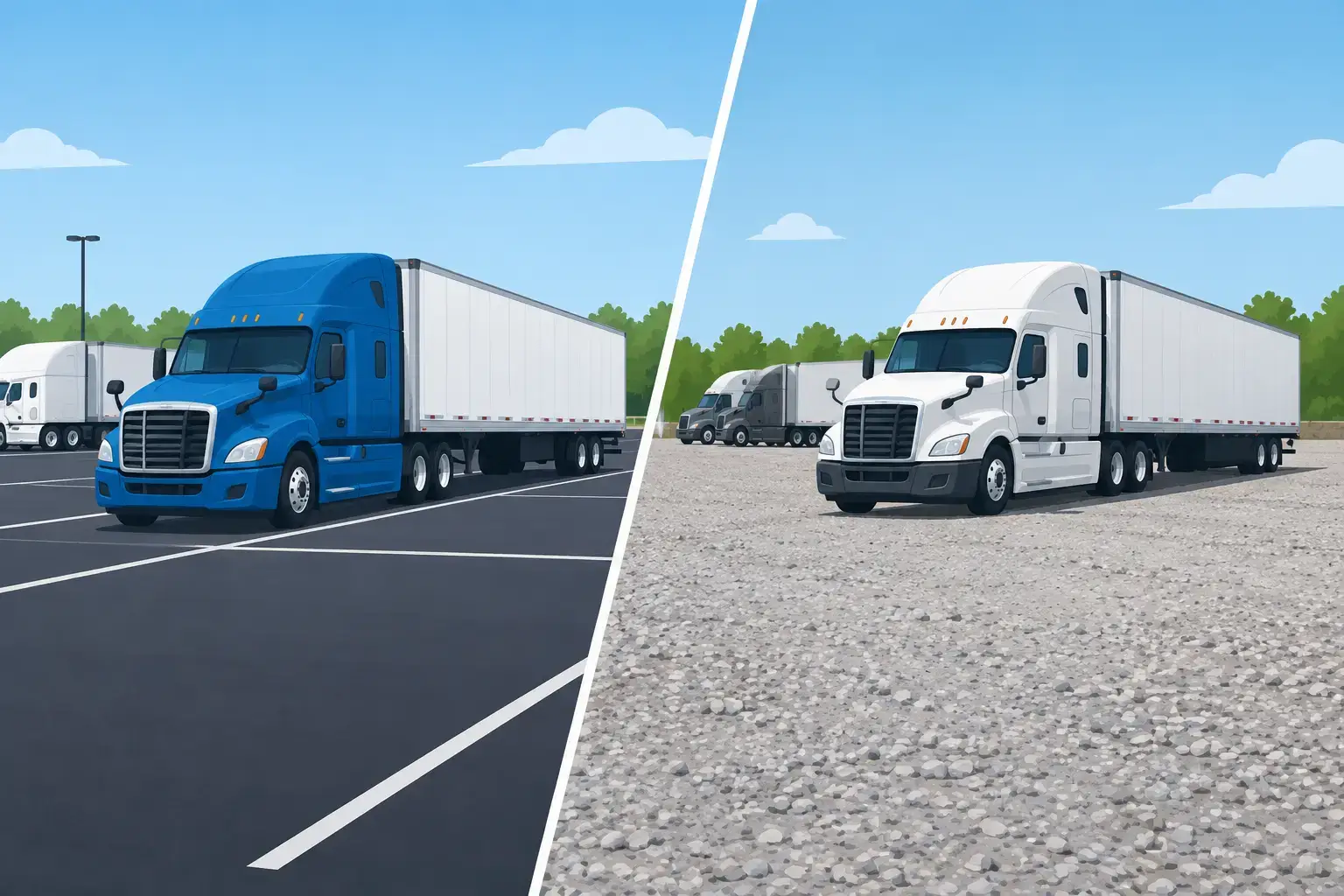
A tractor-trailer can fit on a site and still make it a poor parking operation. The road approach may be tight, a loaded trailer may rut the turning area after rain, or drainage may push standing water into the exact row drivers need. When evaluating paved lots versus gravel yards, the right answer comes down to operating conditions, not appearances.
For property owners, the surface affects site readiness, upkeep, traffic flow, and the type of vehicle demand the property can support. For drivers and fleet managers, it affects maneuvering, traction, cleanliness, tire wear, and whether a space works reliably for a daily stop or recurring storage. A paved lot is not automatically better, and a gravel yard is not automatically a compromise. Each can be a strong commercial parking asset when matched to the right use.
Paved Lots Versus Gravel Yards: Start With the Use Case
A paved lot generally gives a more finished, controlled operating surface. It may be asphalt, concrete, or a combination of paved driving lanes with marked parking areas. Paving often makes sense where vehicles enter and exit frequently, where the property serves customer-facing operations, or where a fleet needs predictable circulation in wet weather.
A gravel yard can be a practical fit for trailer storage, equipment staging, overflow truck parking, container storage, construction vehicles, and other uses that do not require a polished parking-field layout. It can also be easier to adjust over time. A property owner may be able to add or shift parking rows, widen a turn area, or improve soft spots without rebuilding an entire paved section.
The key question is not, "Which surface is best?" It is, "Which surface supports the vehicles, traffic frequency, and access pattern this property can handle?" A well-maintained gravel yard with room for trucks to turn may be more useful than a paved lot with a narrow entrance or limited trailer swing room.
What Pavement Can Do Well
Paved surfaces are often a good match for higher-turnover parking. Drivers arriving at different hours can usually see lane edges and parking boundaries more easily, especially when striping, lighting, and site signage are in place. Pavement also reduces dust and can make routine sweeping, snow removal, and surface inspection more straightforward.
For fleets, pavement may be preferable when drivers are parking tractors and trailers repeatedly, performing pre-trip checks, or using the location as a regular operational base. A smoother surface can make backing, coupling, and walking around equipment more consistent. It may also help owners create clear boundaries between truck parking, employee vehicles, loading areas, tenant access, and off-limits sections.
That said, pavement has its own operational demands. Heavy axle loads, repeated turning, poor drainage, and deferred repairs can lead to cracking, potholes, edge failures, or damaged areas around entrances. A paved lot needs to be evaluated for the kind of equipment it will receive, not simply whether it has blacktop or concrete. A surface designed for passenger vehicles may not hold up the same way under recurring commercial truck traffic.
Owners should also consider where trucks will turn. Tight turns are hard on paved edges, particularly when trailer tires track across the same outside radius every day. Sometimes the best layout uses a defined paved arrival area and a separate, more durable yard section for trailer storage or less-frequent movements.
Where Gravel Yards Make Commercial Sense
Gravel yards are common in industrial, transportation, construction, agricultural, and storage settings because they can support practical working space without the cost or permanence of full paving. When the base is properly built and maintained, gravel can work well for commercial vehicles, trailers, containers, RVs, box trucks, equipment, and staged fleet assets.
A gravel surface is particularly useful when the property needs flexibility. Parking demand changes. A landowner may initially use a section for a handful of trailers, then later designate additional rows as demand and site operations allow. Gravel can make those adjustments more manageable than re-striping or reconstructing a paved lot.
The trade-off is maintenance discipline. Gravel is not a one-time improvement. Truck traffic can create ruts, washboarding, potholes, loose material, and low spots. Wet conditions can expose drainage issues quickly. Dust can become an operational concern in dry climates or near neighboring businesses. A usable gravel yard needs periodic grading, replenishment where needed, and attention to entrances, travel lanes, and high-turn areas.
Not all gravel is equal, either. A thin layer of stone over soft ground is different from a purpose-built aggregate base designed for commercial traffic. Site review should focus on actual ground condition, not just what the surface looks like in a photo.
Drainage Decides More Than Surface Type
Water is often the deciding factor in paved lots versus gravel yards. A paved lot can collect water if it lacks proper slope, drain inlets, or maintained drainage paths. Gravel can drain effectively in some conditions, but it can also wash out, develop soft areas, or hold water when the underlying grade is poor.
Walk the property after weather events when possible. Look for standing water near the entrance, pooled water in parking rows, washed-out gravel, mud at turning points, and areas where tires have cut deep tracks. These conditions affect more than appearance. They influence whether drivers can enter safely, park without getting stuck, and leave without damaging the site.
A site does not need to be perfect to be useful. It does need known boundaries. If a particular corner gets soft during rain, keep it off limits. If the main drive lane remains stable but an outer field section does not, map the usable area accordingly. Clear operating boundaries protect the property and make parking instructions more reliable.
Access and Geometry Matter More Than a Clean Surface
Surface quality is only one part of truck parking capacity. The road approach, entrance width, gate placement, internal turning radius, overhead clearance, and ability to back into a space are often more consequential. A paved site with a difficult approach may be unsuitable for a 53-foot trailer. A gravel site with a wide entrance, straightforward circulation, and designated rows may work very well.
Property owners should assess the full truck path from the public road to the parking area. Can a tractor-trailer make the turn without crossing into a restricted area? Is there enough room for a driver to correct a backing maneuver? Are there buildings, fences, parked vehicles, utility poles, or drainage features that limit movement? Is there a separate area for equipment, tenants, or business operations that must remain protected?
These questions are also why a map and current site photos matter. They help distinguish usable ground from theoretical acreage. A ten-acre parcel may have only a few acres of truck-capable parking after accounting for access, setbacks, buildings, slopes, drainage, and areas the owner needs to retain.
Match the Surface to Vehicle Mix and Stay Length
A high-frequency tractor parking location has different demands from a trailer storage yard. Daily turnover creates more braking, turning, and repeated traffic across entrance lanes. Long-term trailer storage may create less movement but still requires stable pads, room to reposition equipment, and dependable access when a unit needs to leave.
Box trucks, work vans, food trucks, RVs, boats, construction equipment, and containers can also change the calculation. Some fit comfortably on compacted gravel. Others require a smoother or more controlled surface because of their operating pattern, ground clearance, weight distribution, or customer-facing role.
Rather than market every open area the same way, define the vehicle types the site is equipped to serve. This creates a more accurate fit between demand and capacity. It also helps avoid placing a vehicle on a surface or in a location that does not match its operating needs.
Build a Parking Plan Around the Ground You Have
Before opening a site to commercial parking, separate the property into practical zones: truck travel lanes, parking rows, turnaround space, restricted areas, and any areas that need improvement before use. Marking these boundaries does not require overcomplication. It requires an honest view of how vehicles move through the property.
For a paved lot, inspect pavement condition, turning edges, drainage points, striping, and conflicts with other users. For a gravel yard, inspect base stability, rutting, low spots, entrance durability, dust, and the condition of primary lanes. In both cases, take photos that show the road approach, entrance, interior space, and any areas drivers must avoid.
Benchmark Truck Parking evaluates operational fit through the same lens: access, maneuverability, usable space, restrictions, and local demand. Owners can keep existing direct customers and other channels while adding parking capacity where it makes commercial sense.
The most productive next step is simple: look at the property after a normal workday and after a weather event. Identify where trucks can reliably enter, turn, park, and leave, then build the parking plan around that ground.
More articles · Truck parking locations · List your property